





Table of Contents
🔍 Introduction to the University of Manchester Cyber Attack

The University of Manchester cyber attack was a data exfiltration incident detected on 9 June 2023, in which attackers gained unauthorised access to systems at one of the UK’s largest research universities. Reports later confirmed that approximately 7 TB of data was claimed by the attackers, including research, intellectual property, and personal information shared with NHS partners. The University began containment on 14 June 2023, and the attackers subsequently contacted students directly to pressure payment. The incident remains one of the most significant cyber attacks on UK higher education to date.
Key Facts about the University of Manchester cyber attack:
- When: Detected on 9 June 2023; containment measures began on 14 June 2023.
- Victim: The University of Manchester, one of the UK’s largest research universities, with more than 40,000 students.
- Data exfiltrated: Attackers claimed to have stolen approximately 7TB of data, including research, intellectual property and personal information.
- NHS exposure: Reports indicated that more than one million NHS-linked records may have been exposed through shared research datasets.
- Notable feature: Attackers reportedly contacted students directly to pressure the University into paying, making the incident a notable example of tactics associated with “triple extortion” in higher education.
In this article, we’ll break down what happened, why it happened and what other organisations can learn from it. Drawing comparisons with other incidents like the British Library Cyber Attack 2023, we’ll explore the wider trend of universities becoming prime targets for data theft. At CyPro, we help organisations strengthen their defences and reduce the risk of similar breaches. By the end of this piece, you’ll understand how the University of Manchester cyber attack unfolded and what steps can help prevent the next one.
🚨 What was the University of Manchester cyber attack?

The University of Manchester cyber attack affected one of the UK’s largest and most research-intensive universities. While the incident itself involved the theft of data, its significance extends beyond the volume of information exposed. The attack highlighted the unique cyber security challenges facing higher-education institutions that manage large populations, complex networks and valuable research assets.
Why Universities Are Attractive Targets?
- Research data: Universities hold intellectual property, research datasets and commercially valuable information.
- Collaborative networks: Connections with hospitals, government bodies and international partners can expand the attack surface.
- Open-access environments: Academic institutions often prioritise collaboration and accessibility, creating additional security challenges.
- Large user populations: Thousands of students, staff and third-party users increase the risk of phishing and credential compromise.
With more than 40,000 students, thousands of staff and extensive research partnerships, the University of Manchester represents the type of complex environment frequently targeted by cyber criminals. The incident demonstrates how a single breach can affect personal information, research programmes and external partner organisations simultaneously.
 Key Takeaway
 Universities combine open networks with high-value research data, making them prime targets for cyber attacks.
The University of Manchester cyber attack highlights the importance of balancing accessibility with strong cyber security controls.
📅 When did the University of Manchester cyber attack happen?

The University of Manchester cyber attack was first detected on 9 June 2023, when the university identified unauthorised access to its systems. As one of the UK’s largest research institutions and a member of the Russell Group, the University of Manchester moved quickly to investigate the incident and limit further exposure.
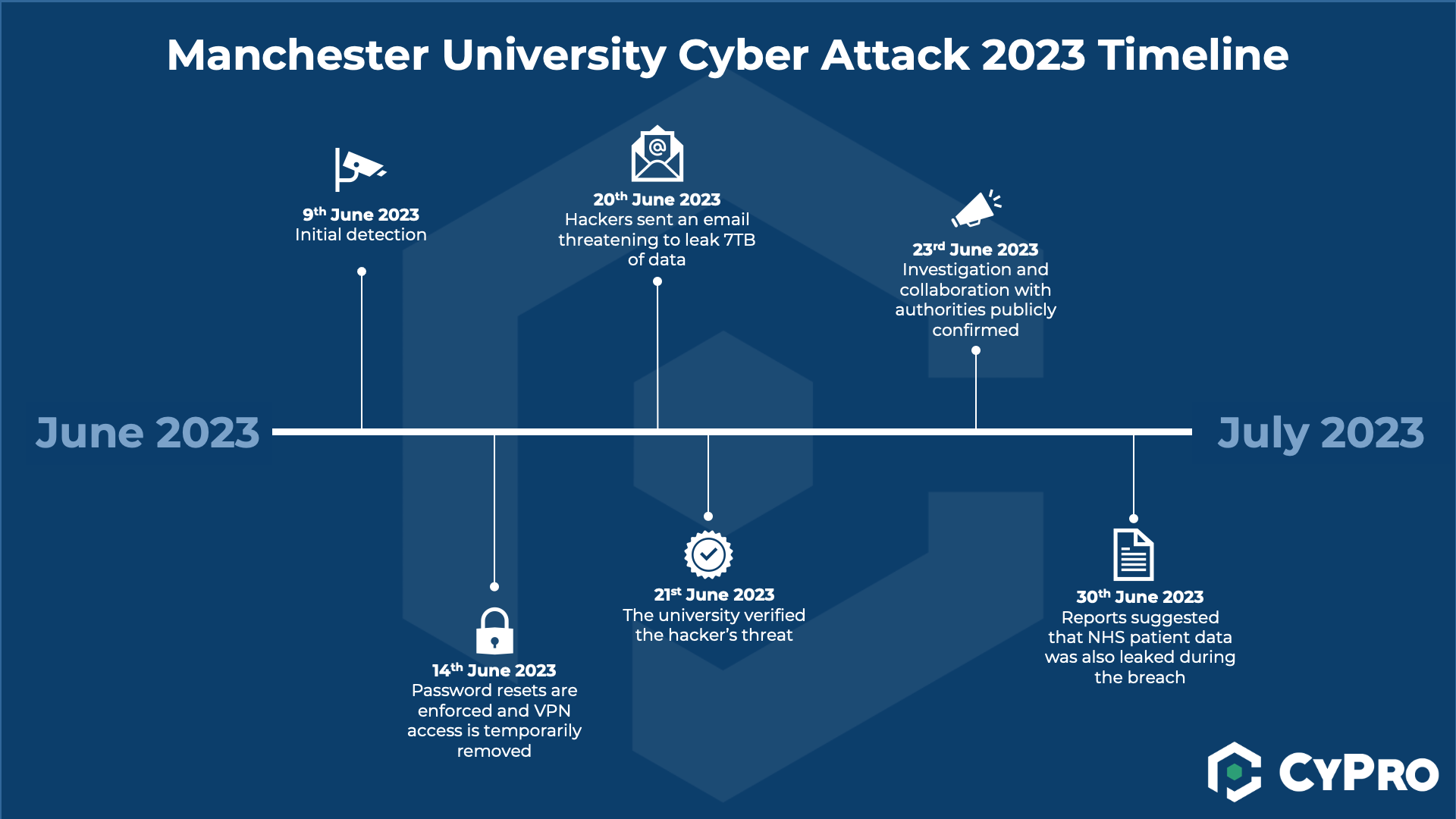
Key Events
- 9 June 2023: The University of Manchester detected unauthorised access to its systems.
- 14 June 2023: Containment measures were implemented to secure affected systems and prevent further unauthorised access.
- Following weeks: Password resets were enforced, VPN access was removed and forensic investigations continued.
- Ongoing response: The University worked with cyber security specialists and relevant authorities to assess the scope of the incident and support recovery efforts.
Registrar Patrick Hackett stated that the priority was to resolve the issue quickly while keeping affected individuals informed. The incident would go on to become one of the most significant cyber attacks to affect the UK higher-education sector, prompting wider discussions around cyber security resilience across universities and research institutions (Computer Weekly).
👤 Who was behind the University of Manchester cyber attack?
The identity of the attackers behind the University of Manchester cyber attack has not been publicly confirmed. Neither the University of Manchester, the National Cyber Security Centre (NCSC) nor law enforcement agencies have formally attributed the incident to a specific threat actor.
Attackers reportedly gained access to university systems, exfiltrated large volumes of data and later contacted students directly following the breach. Rather than focusing on system disruption, the operation appeared to centre on data theft and extortion.
Why was the attack unusual?
Unlike many ransomware incidents that focus on encrypting systems and disrupting operations, the University of Manchester cyber attack centred on data theft and extortion. Attackers reportedly contacted students directly after obtaining information, increasing pressure on the University and broadening the impact beyond the institution itself. The targeting of a Russell Group university and the scale of the alleged data theft made the incident particularly significant within UK higher education.
The incident reflects a broader shift towards data-focused extortion campaigns, where stolen information is used to create reputational and regulatory pressure.
🔓 How did the attackers breach the University of Manchester?

The exact intrusion path used in the University of Manchester cyber attack was not publicly disclosed. However, the incident highlights several common weaknesses that attackers frequently exploit when targeting large, decentralised organisations.
Universities often operate complex digital environments made up of research systems, administrative platforms and third-party services. When access controls, monitoring and governance are inconsistent across departments, attackers may be able to move through networks undetected.
A Likely Attack Sequence
| Stage | Description |
| Initial access | Attackers may have gained access using compromised credentials, a technique mapped to MITRE ATT&CK T1078 (Valid Accounts). |
| Internal reconnaissance | Once inside, attackers could identify valuable systems, research repositories and administrative platforms. |
| Lateral movement | Shared drives and interconnected systems may have enabled movement across the environment (MITRE ATT&CK TA0008 – Lateral Movement). |
| Data access | Research data, personal information and university records became accessible. |
| Data exfiltration | Information was copied from university systems and later used as leverage in an extortion campaign. |
Why are universities vulnerable to these attacks?
- Legacy systems and ageing infrastructure.
- Large student and staff populations.
- Decentralised IT and departmental autonomy.
- Extensive collaboration with research and healthcare partners.
- Inconsistent security controls across faculties and research groups.

At CyPro, we often see organisations benefit from rapid Incident Response & Forensics support after breaches like this. Early engagement helps secure compromised environments, assess exposure and prevent further data loss. For universities managing complex research networks, our Managed Detection & Response service can offer continuous monitoring to catch threats before they escalate.
📂 What data was stolen in the University of Manchester cyber attack?

One of the most concerning aspects of the University of Manchester cyber attack was the volume of information reportedly accessed by attackers. Cyber criminals claimed to have exfiltrated approximately 7TB of data, although the full extent of the breach was never publicly verified by the University.
In an update following the incident, the University of Manchester confirmed that a small proportion of data relating to some students and alumni had been copied. Public reporting also suggested that research-related information may have been affected, reflecting the University’s role as one of the UK’s largest research institutions.
Were NHS records exposed?
The breach attracted additional attention after reports suggested that NHS-linked research data may also have been affected. According to reporting from Digital Health , more than one million records connected to NHS research datasets were potentially exposed, including NHS numbers and partial postcode information.
While the full extent of the exposure was not publicly confirmed, the involvement of NHS-linked data significantly increased the seriousness of the incident. It also highlighted the close relationship between universities, healthcare organisations and research partners, where a cyber attack affecting one institution can have wider implications across multiple sectors.
Key Takeaway The University of Manchester cyber attack demonstrated how a breach at a single institution can have far-reaching consequences.
The reported exposure of NHS-linked research data highlighted the need for strong cyber security, effective data governance and close oversight of shared datasets across higher education and healthcare.
🎓 What was the impact on students and staff?

The University of Manchester cyber attack affected far more than IT systems. Students, staff and research partners faced uncertainty over how their information may have been used, while the University worked to investigate the breach and secure affected systems.
Impact Snapshot
- Students – Personal information relating to some students was copied, and reports indicated that attackers contacted individuals directly following the breach.
- Staff – Staff were affected by security measures, including password resets and restricted access to systems.
- Research – Some research activities and collaborative projects were temporarily disrupted while investigations continued.
- Reputation – The incident attracted national attention and raised concerns around data security within higher education.
The attack also prompted wider discussions about cyber security, data governance and risk management across universities and research institutions. As higher education becomes increasingly connected to healthcare, government and commercial partners, the consequences of a breach can extend far beyond campus.
Organisations facing similar challenges often strengthen their monitoring, incident response and governance processes following a major cyber incident. This is an area where CyPro supports universities and research organisations looking to improve resilience against future threats.
📅 Timeline of Events: University of Manchester Cyber Attack 2023

The cyber attack developed quickly during June 2023, with new details emerging as the University investigated the breach and wider reporting revealed the potential scale of exposure.
| Date | Event | Why it mattered |
| 9 June 2023 | Unauthorised access detected | The University identified the breach and notified staff and students. |
| 14 June 2023 | Containment measures begin | Password resets were enforced and VPN access was removed to reduce further risk. |
| 20 June 2023 | Attackers claim access to data | Hackers alleged they had obtained approximately 7TB of data and threatened public exposure. |
| 21 June 2023 | Students and alumni data confirmed as copied | The University confirmed that a small proportion of data relating to some students and alumni had been copied. |
| 23 June 2023 | The University issue a public update | The update confirmed ongoing forensic investigation and work with relevant authorities. |
| 30 June 2023 | NHS-linked exposure reported | Reporting suggested that NHS-linked research data may also have been affected, widening the incident beyond the University itself. |
The timeline shows how quickly the incident moved from initial detection to wider concerns about cross-sector data exposure. It also underlines the importance of fast containment, clear communication and coordinated incident response when universities handle sensitive research data.
🏫 How does the University of Manchester cyber attack compare with other UK university breaches?

This cyber breach was one of the most significant cyber incidents to affect UK higher education in recent years. While universities have long been targeted by ransomware groups and other threat actors, the scale of the alleged data theft, the potential exposure of NHS-linked records and reports that attackers contacted students directly made this breach particularly notable.
Importantly, it was not an isolated event. Jisc’s cyber threat intelligence reporting has repeatedly highlighted ransomware, phishing, compromised credentials and data extortion as persistent threats facing UK universities and research institutions. As a result, organisations such as Jisc CSIRT and the National Cyber Security Centre (NCSC) continue to support institutions in strengthening their cyber resilience and incident response capabilities.
| Institution | Year | Reported Impact |
| University of Manchester | 2023 | ~7 TB exfiltrated; NHS-linked data exposed; students contacted by attackers |
| Lancaster University | 2019 | Phishing breach exposed applicant data |
| Newcastle University | 2020 | DoppelPaymer ransomware; weeks of disruption |
| University of Greenwich | 2016 | ICO £120,000 fine for exposing personal data |
| University of Wolverhampton | 2021 | Cyber attack disrupted systems on results day |
| Blackbaud incident (multi-uni) | 2020 | Affected ~20+ UK universities via shared CRM vendor |
While each incident differed in scope and impact, they share common themes: complex IT environments, valuable data and large user populations. The University of Manchester case stands out because it combined the challenges of protecting personal information, research data and NHS-linked datasets within a single breach, illustrating the unique cyber security pressures facing modern universities and Russell Group institutions alike.
 Case Study – Protecting Research Networks in a UK University
 We worked with a mid-sized UK university that faced repeated phishing attempts targeting its research staff. Our team conducted a full review of their access controls, implemented behavioural monitoring tools and ran tailored awareness sessions for academic departments.
Within six months, phishing success rates dropped by 78% and unauthorised login attempts were identified 40% faster. This proactive approach helped safeguard sensitive research collaborations and improved confidence among staff handling crucial data.
🛡️ What can UK universities learn from the University of Manchester cyber attack?
The University of Manchester cyber attack highlighted the unique cyber security challenges facing modern universities. Open collaboration, valuable research data and complex partner networks all increase the potential impact of a breach.
Strengthen identity and access management
Many cyber attacks begin with compromised credentials. Universities should regularly review user permissions, implement multi-factor authentication (MFA) and remove access when staff, students or third-party partners no longer require it.
Improve visibility across complex environments
Large institutions often operate hundreds of systems across faculties, research centres and administrative departments. Without effective monitoring, suspicious activity can go unnoticed until data has already been accessed or exfiltrated.
Treat research data as a critical asset
Universities hold far more than student records. Research datasets, intellectual property and shared information from external partners can all be valuable targets for attackers. The reported exposure of NHS-linked research data in the University of Manchester cyber attack demonstrates how the consequences of a breach can extend beyond a single institution.
Make cyber security part of governance
Cyber security should not sit solely with IT teams. Frameworks such as ISO 27001, alongside obligations under the UK GDPR and Data Protection Act 2018, can help institutions establish clearer accountability and stronger governance practices.
Jisc’s cyber threat intelligence reporting continues to highlight ransomware, phishing, compromised credentials and data extortion as persistent threats across UK higher education. The University of Manchester incident serves as a reminder that cyber resilience requires ongoing investment in people, processes and technology, not just reactive responses after a breach.
🤝 How CyPro helps UK higher-education institutions reduce cyber risk

The University of Manchester cyber attack highlighted several challenges that are common across higher education, including complex user environments, valuable research data, legacy infrastructure and extensive third-party partnerships. CyPro helps universities, research institutions and public-sector organisations address these risks through a combination of proactive security assessments, continuous monitoring and incident response support.
Case Study – Securing Legacy Access in a UK Research Institution We supported a regional research institute that had suffered repeated credential compromises through outdated remote-access systems. Our team introduced MFA across all admin accounts, retired legacy VPNs and deployed behaviour-based detection to flag unusual logins..
Within four months, unauthorised access attempts dropped by 82%, and lateral movement was successfully blocked during a simulated breach exercise. By modernising access management and centralising monitoring, we helped the organisation regain trust in its digital research environment and reduce exposure to credential-based attacks.
How CyPro supports universities
Identify hidden exposure
Universities often operate large, decentralised environments where internet-facing systems can be difficult to track. CyPro’s Attack Surface Assessment helps institutions identify exposed assets, misconfigurations and potential entry points before attackers discover them.
Improve visibility and detection
CyPro supports organisations with incident response planning, threat monitoring and managed detection and response (MDR), helping security teams identify threats earlier and respond more effectively across complex environments.
Strengthen governance and resilience
From cyber risk assessments and incident response planning to support with security frameworks such as ISO 27001, CyPro helps higher-education institutions build stronger governance around research data, personal information and critical systems.
Whether reviewing legacy infrastructure, assessing external exposure or strengthening cyber resilience across research networks, CyPro helps universities take practical steps to reduce risk before a cyber incident occurs.
❓ Frequently Asked Questions
When did the University of Manchester cyber attack happen?
The University of Manchester detected the cyber attack on 9 June 2023 and began containment on 14 June 2023. Attackers subsequently contacted students directly on or around 20 June 2023, claiming to have access to large volumes of personal and research data.
How much data was stolen in the University of Manchester cyber attack?
Attackers claimed access to approximately 7 TB of data, including research files, intellectual property, and personal information. Reporting also indicates that over one million NHS-linked records held within shared research datasets were potentially exposed.
Who was behind the University of Manchester cyber attack?
The University did not publicly name the threat actor. Sector reporting noted that the attackers contacted students directly to apply pressure – a “triple extortion” tactic associated with several known ransomware groups active against UK and US higher education in 2023.
How did the attackers get into the University of Manchester’s systems?
According to publicly available analysis, the attackers used compromised valid credentials (mapped to MITRE ATT&CK T1078) to gain initial access, then moved laterally across the academic network. Universities typically have large, federated environments where lateral movement is easier than in commercial enterprises.
Were NHS records exposed in the University of Manchester cyber attack?
Yes – reporting confirmed that NHS-linked datasets used in University research were among the data accessed. Estimates put the number of NHS-related records potentially exposed at over one million, although the exact volume of confirmed exfiltration was never publicly disclosed.
Did the University of Manchester pay the ransom?
The University did not publicly confirm any ransom payment, in line with NCSC guidance, which discourages payment because it funds organised crime and does not guarantee data recovery.
What can UK universities learn from the University of Manchester cyber attack?
The University of Manchester cyber attack underscores three lessons for the higher-education sector: (1) enforce multi-factor authentication on every account, including federated identity systems and student-staff shared services; (2) classify and segment NHS- and research-partner-linked datasets so a single account compromise cannot reach them; (3) work with Jisc CSIRT and NCSC to maintain a tested incident response plan that includes a communications playbook for direct student contact attempts.