






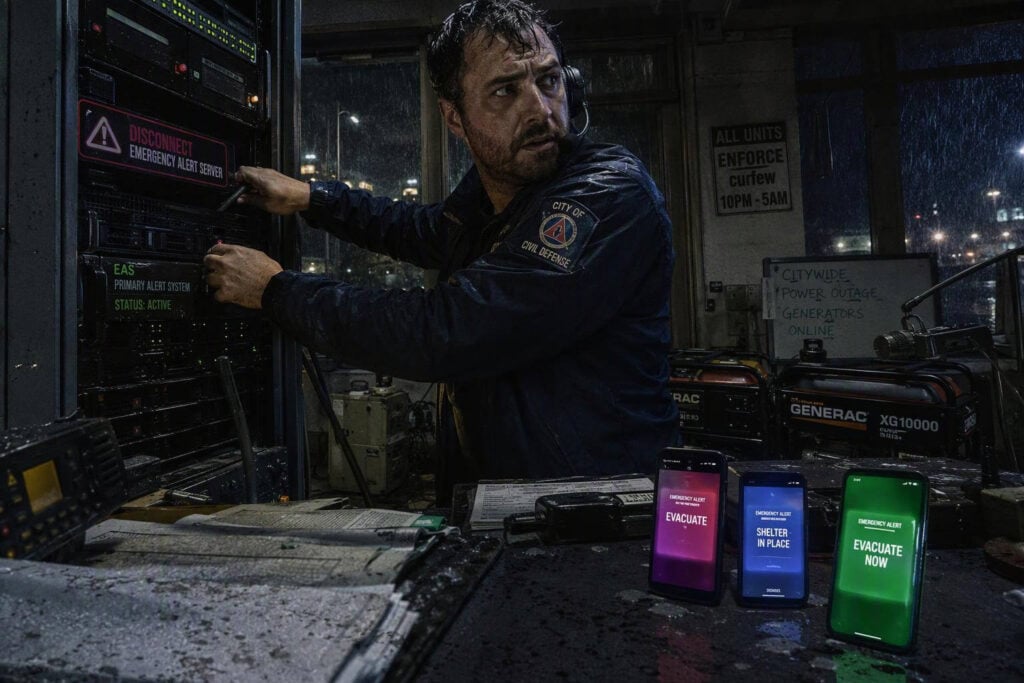
An emergency alert app hack sent false nuclear, chemical and street fighting warnings to residents of Ukraine and Russia. The incidents affected trusted public warning channels during the night of 1 November and the early hours of 2 November 2026.
Attackers demonstrated that compromising a notification service can cause immediate disruption without disabling the wider emergency infrastructure. Both countries confirmed malicious interference, but neither had disclosed the initial access method or a verified attribution at the time of publication.
Emergency alert app hack begins in Ukraine
Ukraine’s incident began at approximately 22:47 Kyiv time on Sunday 1 November 2026. Users of the officially supported Air Alert mobile application received a message declaring a radiation threat in Kyiv.
At approximately 22:48, a second notification appeared in Russian. It claimed that there would be a nuclear alert across Ukraine and referred to an Oreshnik missile, an intermediate-range Russian ballistic missile capable of carrying conventional or nuclear warheads.
Further false messages followed at approximately 22:49. One warned of a chemical attack in Kyiv and instructed residents not to go outside. Another stated that street fighting was taking place in the capital.
The sequence included several types of emergency warning:
- A red-level air raid warning across Ukraine.
- A supposed radiation threat in Kyiv.
- A nuclear alert referencing an Oreshnik missile.
- A warning of a chemical attack in Kyiv.
- A claim that street fighting was under way in the city.
At 23:53, the application sent individual all-clear notifications corresponding to the earlier false warnings. The rapid sequence gave the messages the appearance of genuine updates moving through an official alerting process.
Ukraine disables Air Alert notifications
Ukraine’s Air Force said the application appeared to have experienced hostile interference and advised the public to follow official information channels. The Ministry of Digital Transformation temporarily took the app out of operation while street sirens and other public warning systems continued to work.
Developers disabled push notifications to contain the emergency alert app hack and prevent further unauthorised broadcasts. Officials directed residents towards alternative verified services, including Kyiv Digital and physical sirens.
The affected product was Air Alert for Android and iOS. It was developed by Ajax Systems and Stfalcon with support from Ukraine’s Ministry of Digital Transformation. No affected version numbers were disclosed, so users could not identify the incident with a particular release of the application.
At 02:18 local time on 2 November 2026, reports stated that Air Alert push notifications had been restored after additional security measures were introduced. Threat levels on the map were also being restored gradually, although the display of aerial assets remained suspended.
Some reporting said a radiation warning also played through loudspeakers in the Lviv region. However, that detail had not been confirmed through a primary Ukrainian government statement and should therefore be treated cautiously.
Russia reports a similar emergency alert app hack
In the early hours of Monday 2 November 2026, Russia’s Emergencies Ministry said its own mobile application had been subjected to a massive cyberattack. According to the ministry, the attackers gained the ability to distribute false information to members of the public.
Reports said users received fake nuclear threat notifications, including messages referring to nuclear warheads carried by drones. The ministry said specialists were working to remove the vulnerability and return the service to normal operation.
The Russian product was the official mobile application of the Ministry of Emergency Situations, which is available for Android and iOS. As with the Ukrainian incident, authorities did not identify affected application versions.
Media reports relayed a claim of responsibility from Atesh, a Ukrainian-aligned partisan group, in connection with the messages delivered through Russia’s app. This remains an unverified claim rather than an official technical attribution.
How the false warning attacks worked
The confirmed outcome in both incidents was unauthorised access to a trusted notification channel. Attackers were able to make official applications deliver fabricated emergency messages directly to users’ phones.
In Ukraine, the containment measures indicate that the push notification pipeline had been interfered with. Disabling that pipeline stopped the application from broadcasting additional false warnings while developers investigated and added security controls.
However, no technical root cause has been published. It is not known whether the emergency alert app hack involved stolen administrator credentials, a compromised management console, an application programming interface, a third-party messaging provider or a previously unknown software vulnerability.
Russia’s Emergencies Ministry similarly said the attack enabled false information to be distributed, but it did not explain how access was obtained. References to eliminating a vulnerability do not establish whether the weakness existed in the mobile app, a supporting server or an administrative system.
No public proof of concept, exploit code or reproducible attack method has been identified. There is also no evidence in the available reporting that individual phones were compromised. The false content appears to have been distributed centrally through services trusted by the applications.
Current exploitation and attribution status
This was confirmed in the wild exploitation, not a theoretical vulnerability. End users in both countries received malicious messages through official public warning applications within the reported time window.
Attribution remained unconfirmed on 2 November 2026. Ukrainian officials described hostile interference, while Russia blamed a massive cyberattack. Neither country had published forensic evidence establishing who gained access or whether the two incidents were technically connected.
No official indicators of compromise had been released. Administrators therefore had no incident-specific IP addresses, domains, file hashes or device artefacts with which to search their environments.
Why the emergency alert app hack matters
Emergency applications depend on speed and public trust. A fabricated alert can prompt people to seek shelter, avoid an area or disregard later messages. Repeated false warnings may also reduce confidence in genuine instructions during a real emergency.
The incident shows that attackers do not need to disable core infrastructure to produce a serious operational effect. Hijacking a trusted communications layer can create confusion while sirens, monitoring systems and other warning mechanisms remain functional.
Actions for organisations using push notifications
UK organisations using mobile alerts for safety, logistics or customer communications should review the controls protecting their notification services. The response plan should account for both service outages and deliberate misuse of an authorised channel.
- Restrict access to messaging consoles and require multi-factor authentication for every privileged account.
- Apply least privilege so staff and service accounts can send only the messages needed for their roles.
- Log administrative activity and alert on unusual broadcasts, new accounts or changes to notification templates.
- Prepare a rapid method for suspending push messages without disabling every other safety system.
- Maintain a verified alternative channel for correcting false information and confirming genuine alerts.
Organisations should also tell recipients not to follow links embedded in unexpected emergency notifications. During the Ukrainian response, officials specifically warned that suspicious links could be phishing attempts, making clear and prompt correction messages an important part of containment.
Originally reported by bbc.com.


