





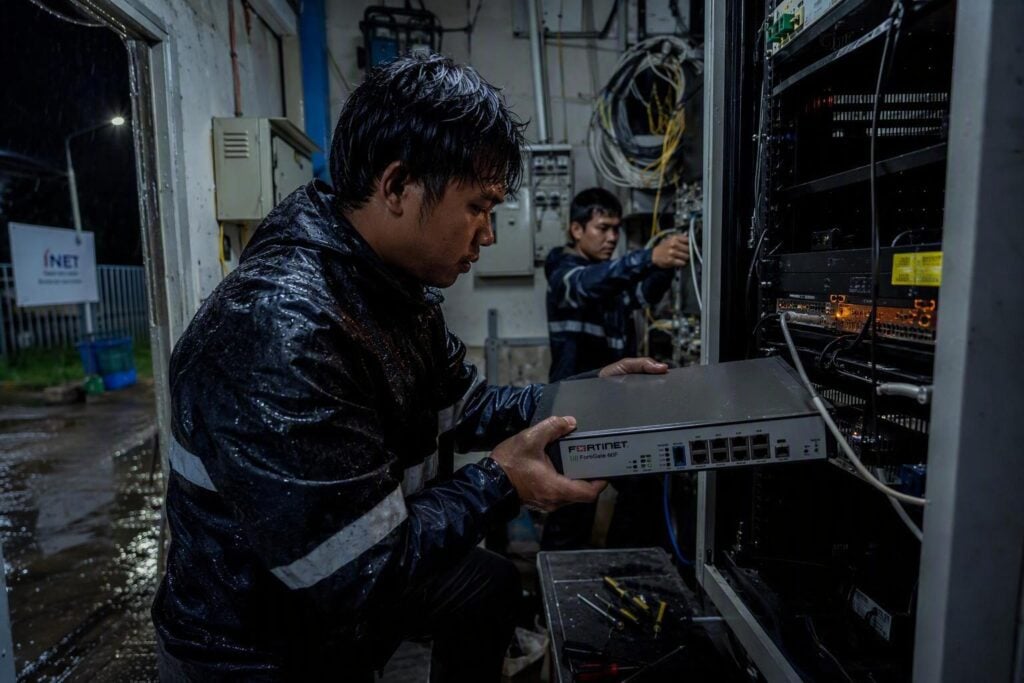
A Fortinet vulnerability has been used to compromise a broadband provider in Thailand. The attackers reportedly staged an extensive collection of scripts and utilities inside the provider’s environment.
The incident was reported on 15 September 2026. Although the available report does not identify the provider, vulnerability identifier, Fortinet product or affected firmware versions, it reveals important details about the attackers’ post-compromise capabilities and likely objectives.
How the Fortinet vulnerability led to compromise
The attackers gained access to the Thai broadband provider through a Fortinet vulnerability, according to the report. This makes the incident an example of exploitation in a real attack, rather than a vulnerability that has only been demonstrated by security researchers.
No CVE number was included in the available reporting. The affected Fortinet appliance and its software version were also not specified, so organisations should not assume that the incident relates to any particular Fortinet advisory or product family without further evidence.
Following the compromise, the attackers staged numerous scripts within the provider’s environment. In this context, staging means placing tools or code on a compromised system so that they are ready to be used during later phases of an intrusion.
The presence of staged files does not prove that every tool was executed successfully. However, the range of capabilities indicates that the attackers were preparing to examine the environment, identify additional weaknesses, obtain credentials and seek higher levels of access.
Reconnaissance and CVE probing scripts
Some of the staged scripts were designed for reconnaissance. These tools can help an intruder collect information about reachable systems, services, software and network configuration after obtaining an initial foothold.
The attackers also placed scripts intended to probe for CVEs. Such probing can be used to test other systems for known vulnerabilities, potentially allowing an intrusion that began through one Fortinet vulnerability to spread to additional devices or applications.
The report does not name the CVEs targeted by these scripts, state how many systems were scanned or confirm whether any secondary exploitation succeeded. It also does not establish whether the scripts were written specifically for this provider or assembled from an existing attacker toolkit.
Brute-force utilities and privilege escalation tools
Brute-force utilities formed another part of the staged collection. These tools repeatedly test credentials or authentication combinations, potentially helping attackers access additional accounts or services when passwords are weak, reused or otherwise exposed.
Privilege escalation tools were also present. Their purpose is to help an attacker move from a restricted account or process to one with more powerful permissions, such as administrative or system-level access.
Together, these capabilities suggest activity beyond a quick scan of an exposed appliance. The attackers had prepared tooling that could support discovery, vulnerability testing, credential attacks and attempts to deepen their control of the environment.
What is confirmed about the Fortinet vulnerability attack
The confirmed event details remain limited, but the available information distinguishes the incident from a general warning about vulnerable technology. A Thai broadband provider was compromised, a Fortinet vulnerability was identified as the route used by the attackers, and multiple categories of offensive tooling were staged following access.
The key reported facts are:
- A broadband provider operating in Thailand was the victim.
- Attackers exploited a vulnerability affecting Fortinet technology.
- Numerous scripts were staged for internal reconnaissance and CVE probing.
- Brute-force utilities were placed in the compromised environment.
- Privilege escalation tools were also staged.
- The incident was publicly reported on 15 September 2026.
Several details needed for precise exposure assessment were not provided. These include the provider’s identity, the CVE identifier, the vulnerable Fortinet product, affected versions, patch status at the time of compromise and the date when the initial intrusion occurred.
The reporting also does not say whether customer information, authentication data or network traffic was accessed. There is no confirmed information about service disruption, data theft, ransomware deployment or communications from the attackers.
Current exploitation status and scope
For the unspecified Fortinet vulnerability involved, exploitation is confirmed in the context of this incident. The report does not establish whether the same weakness is being exploited widely, whether the attackers targeted other providers or whether the compromise formed part of a broader campaign.
It is therefore important to separate the confirmed attack from possible wider activity. This case shows successful exploitation against one provider, but the available evidence does not support conclusions about the number of victims, the attackers’ identity or their ultimate motive.
The exact sequence after initial access is similarly unclear. The tools indicate several intended capabilities, but there is no published timeline showing which scripts were run, what results they produced or how long the attackers remained inside the environment.
Why this Fortinet vulnerability incident matters
Fortinet appliances are often positioned at important network boundaries. When such a device is exposed to the internet or provides remote access, a successfully exploited flaw can create an entry point into systems that would not otherwise be directly reachable.
The incident is particularly relevant because the attackers appear to have arrived prepared for follow-on activity. Their staged toolkit could support efforts to map internal infrastructure, test other vulnerabilities, attack credentials and seek stronger permissions.
For UK small and medium-sized businesses using Fortinet products, the practical lesson is not to assume that exploitation would remain confined to the edge device. Investigation should account for the possibility that tools or scripts were transferred elsewhere after access was gained.
Actions for organisations using Fortinet products
Because the report does not identify the relevant CVE or affected versions, organisations should avoid relying on a single assumed patch. They should instead verify their complete Fortinet asset inventory against current vendor security advisories and confirm that supported firmware is installed.
Priority actions tied to this incident include:
- Identify all internet-facing Fortinet appliances, including devices managed by third parties or located at branch offices.
- Review Fortinet security advisories and compare listed affected versions with the firmware actually running on each device.
- Restrict administrative interfaces to trusted management networks or approved addresses wherever operationally possible.
- Examine appliance and network logs for unexpected downloads, script execution, reconnaissance, repeated login attempts and unusual privilege changes.
- Search connected systems for unfamiliar probing, brute-force or privilege escalation utilities.
- If compromise is suspected, preserve evidence before rebuilding or upgrading devices, then rotate potentially exposed administrative credentials.
- Require strong authentication for remote and administrative access, including multi-factor authentication where supported.
These checks should cover activity beyond the Fortinet device itself. The collection of tools described in the incident means that internal hosts, accounts and management systems may require examination if suspicious appliance activity is found.
Originally reported by securityweek.com.

