




At CyPro, we analyse the Jaguar Land Rover cyber attack as a 2025 UK incident handled with government and industry coordination. The National Cyber Security Centre (NCSC) confirmed it was working directly with Jaguar Land Rover (NCSC, 2025), and the UK Government issued a joint statement after a supplier meeting (gov.uk, 2025).
In light of the Jaguar Land Rover cyber attack, organisations must evaluate their cyber security frameworks and improve incident response strategies. The attack highlighted the vulnerabilities in automotive cyber security and the need for proactive measures against future threats.
To frame attack patterns, the European Union Agency for Cybersecurity analysed 4,875 incidents in its 2025 report (ENISA, 2025) and Verizon examined 22,052 incidents and 12,195 breaches in its 2025 Data Breach Investigations Report (Verizon, 2025). IBM reported the UK remained the most attacked country in Europe in 2025 (IBM, 2025).
Table of Contents
🗓 What Happened and When?
This timeline summarises public milestones around the Jaguar Land Rover cyber attack in 2025, focusing on statements, coordination and recovery context. It reflects disclosure dates and public reporting rather than every internal action.
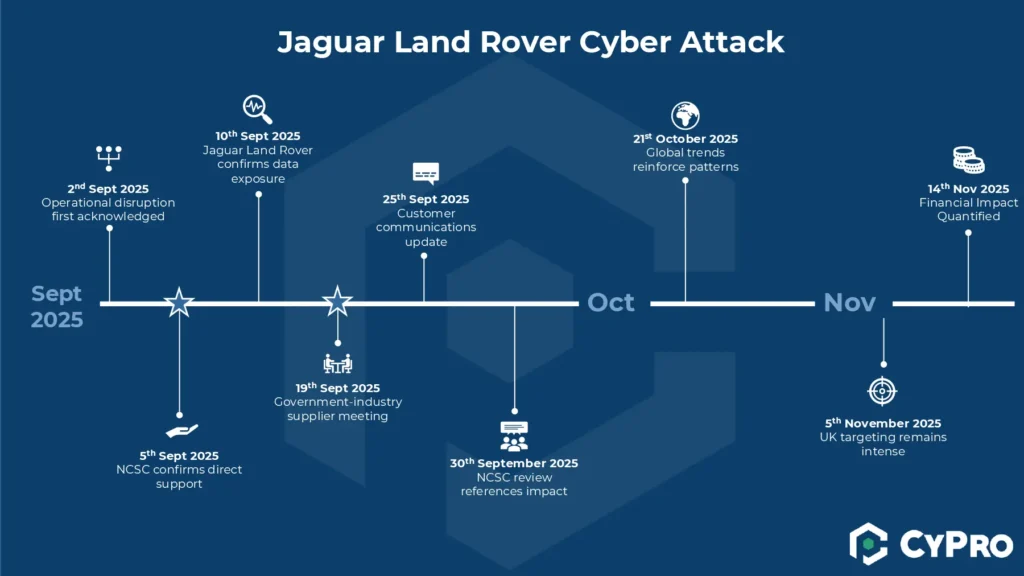
The timeline of the attack reveals critical moments that shaped the response strategy and recovery efforts.
- : Operational disruption first acknowledged: Jaguar Land Rover (JLR) issued its first official statement confirming it had been impacted by a cyber incident. The company stated it had proactively shut down systems to mitigate the attack and warned that retail and production activities had been “severely disrupted”. (JLR statement)
- : NCSC confirms direct support: The National Cyber Security Centre stated it was working with JLR and government partners on the incident, providing technical guidance and coordination. (NCSC statement)
- 10 Sept 2025:Jaguar Land Rover confirms data exposure: JLR revised its earlier position and stated that forensic investigations now indicated “some data has been affected.” The company confirmed regulators were being informed and that impacted individuals would be contacted where appropriate. (JLR statement)
- : Government-industry supplier meeting: A joint statement detailed engagement across government, JLR, and suppliers to manage operational impact and supply chain risk, and to share indicators of compromise. (gov.uk)
- : Customer communications update: JLR briefed customers and retailers on phased service restoration, advising of slower processing times and prioritisation of safety-essential and warranty-related tasks. (JLR statement)
- : NCSC review references impact: The 2024-2025 Annual Review referenced high-profile incidents affecting UK firms’ operations and margins, aligning with lessons emerging from the Jaguar Land Rover cyber attack. (NCSC Annual Review 2025)
- : Global trends reinforce patterns: Verizon’s Data Breach Investigations Report (DBIR) highlighted partner compromise and credential misuse as common paths in large-enterprise breaches, reflecting vectors under examination in automotive supply chains. (Verizon DBIR 2025)
- : UK targeting remains intense: IBM X‑Force noted the UK as the most-attacked country in Europe by incident share, underscoring persistent pressure on manufacturers and their suppliers. (IBM X‑Force 2025)
- 14 Nov 2025: Financial Impact Quantified: JLR reported substantial financial losses linked to the cyber incident, posting a £485m quarterly loss following major operational disruption and production stoppages caused by the attack. (BBC)
 Key Takeaway
Coordinated support from the National Cyber Security Centre and UK government helped stabilise operations and supplier risk while Jaguar Land Rover restored services in phases.
Coordinated support from the NCSC and UK government helped stabilise operations and supplier risk while services were restored in phases.
| Date | Event | System or Actor Affected | Outcome |
|---|---|---|---|
| 2 Sept 2025 | Disruption acknowledged | Dealer and back-office systems | Containment, segmentation and contingency processes limited operational impact. |
| 5 Sept 2025 | NCSC support confirmed | JLR and government partners | Technical guidance and coordinated response initiated. |
| 19 Sept 2025 | Government-industry meeting | Government, JLR, and suppliers | Supply chain risk managed and indicators shared. |
| 25 Sept 2025 | Customer update | Retailers and customers | Phased restoration with slower processing communicated. |
| 30 Sep 2025 | NCSC Annual Review | UK firms and operations | Incident referenced as part of wider operational impacts. |
For organisations watching the Jaguar Land Rover cyber attack, early containment and coordinated response were decisive. If you lack an on-call team, line up expert incident response support before you need it. Build supplier controls and practice escalation with government and sector bodies so coordination is fast when disruption starts.
🧩 How did the attack unfold?

The full attack chain has not been publicly disclosed. While the UK Government and National Cyber Security Centre confirmed coordination and supplier engagement during the incident, neither identified the initial entry vector or root cause.
Likely attack stages
Based on common patterns seen in European manufacturing breaches, the Jaguar Land Rover cyber attack may have involved:
- Phishing or credential theft (T1566, T1078)
- Exploitation of remote access services or VPNs (T1190)
- Lateral movement using valid accounts and remote services (T1021)
- Use of native tooling such as PowerShell or WMI (T1047)
- Possible data exfiltration or extortion activity (T1041, T1486)
These techniques are frequently referenced in the European Union Agency for Cybersecurity’s annual analysis (ENISA threat environment 2025) and the 2025 Data Breach Investigations Report (Verizon DBIR 2025) covering manufacturing and supply-chain intrusions across Europe and the UK.
What remains unconfirmed
No public source has confirmed:
- The initial access vector
- Supplier compromise as the entry point
- Ransomware deployment
- Data exfiltration activity
- Specific accounts, systems or vulnerabilities involved
The Jaguar Land Rover cyber attack reflects broader manufacturing attack patterns involving identity compromise, supplier access and lateral movement across complex environments.
| Technique ID | Description | How it relates here |
|---|---|---|
| T1566 | Phishing | Plausible initial access via user deception and credential capture. Not confirmed by public sources. |
| T1190 | Exploit Public-Facing Application | Plausible exploitation of an exposed service as a start point. No Common Vulnerabilities and Exposures (CVEs) publicly attributed. |
| T1078 | Valid Accounts | Commonly used for authenticated access and persistence in EMEA incidents. Specifics not disclosed here. |
| T1021 | Remote Services | Potential lateral movement between servers using Remote Desktop Protocol (RDP) or similar administrative access. |
| T1047 | Windows Management Instrumentation | Potential use of native admin tooling for discovery and movement inside the environment. |
| T1041 | Exfiltration Over Command and Control (C2) Channel | Plausible staging and transfer of data prior to extortion. Not confirmed here. |
| T1486 | Data Encrypted for Impact | Common pressure tactic in manufacturing, but not confirmed in this incident. |
Overall, a cautious reconstruction for the attack is: Unknown initial access, followed by possible expansion using valid accounts and remote services, then discovery and potential staging for exfiltration. Some phases may have overlapped. Given the undisclosed vector, the practical focus should be identity controls, continuous monitoring, and supplier access hygiene, supported by capabilities like 24/7 cyber security monitoring and rapid Cyber Incident Response.

🕵 Who is the Attacker and What is their History?
Public attribution for the Jaguar Land Rover cyber attack has not been confirmed. No named group has been formally identified, and no UK authority has published a definitive actor profile. Available public material points to common tactics seen against European manufacturers.
Why attribution remains unclear
The lack of attribution is not unusual in large supply-chain incidents involving:
- Multiple organisations
- Third-party supplier access
- Cross-border investigations
- Shared infrastructure and credentials
Public reporting and threat intelligence instead point toward broader patterns of financially motivated intrusion activity targeting UK manufacturers and critical supply chains.plier access, identity misuse and financially motivated intrusion activity targeting UK organisations.
Wider manufacturing threat trends
The National Cyber Security Centre and ENISA have both highlighted manufacturing, logistics and automotive organisations as frequent targets for:
- Ransomware and extortion activity
- Supplier compromise
- Credential theft and identity misuse
- Operational disruption attacks
These attacks are often designed to maximise financial pressure and operational disruption rather than maintain long-term persistence inside networks.
Key Takeaway
The Jaguar Land Rover cyber attack reflects a broader increase in financially motivated attacks targeting manufacturers and complex supply chains across the UK and Europe.
Implications for UK automotive supply chains
For organisations operating large supplier ecosystems, the incident reinforces the importance of strong identity controls, supplier governance and continuous monitoring. At CyPro, our Cyber Attack Surface Assessment is a practical way to identify internet-facing weaknesses that attract the same tactics seen in manufacturing incidents.
⚖️ What was the regulatory and legal response?

The UK Information Commissioner’s Office (ICO) oversees personal data issues under UK General Data Protection Regulation (GDPR), while the National Cyber Security Centre provides technical support during major cyber incidents. Under UK GDPR, organisations are expected to assess risk quickly and notify the ICO within 72 hours where personal data risk exists. The 72-hour rule remains the anchor for notification timing under UK GDPR.
ICO and UK GDPR expectations
The Jaguar Land Rover cyber attack highlights the importance of rapid risk assessment, evidence gathering and incident notification under UK GDPR. Where high risk to individuals exists, organisations must also inform affected data subjects without undue delay.
The ICO publishes incident response guidance to help organisations structure decisions and maintain evidence during cyber incidents. While the ICO has not publicly announced enforcement action linked specifically to the attack, comparable UK cases show that enforcement often focuses on governance failures and inadequate security controls. In 2026, the ICO announced a fine of nearly £1 million in a UK utilities case linked to cyber security failings (ICO).
Government and sector engagement
The UK Government and the NCSC publicly referred to their role in the Jaguar Land Rover cyber attack, including supplier coordination, advisory support and resilience planning. NCSC engagement does not replace legal obligations under UK GDPR, but it can materially improve technical response quality and cross-sector coordination.
Future measures should be informed by the extensive lessons from the Jaguar Land Rover cyber attack, promoting a culture of resilience and preparedness.

💷 Financial and Economic Impact
The financial consequences of the Jaguar Land Rover cyber attack extended well beyond immediate operational disruption, affecting production output, supplier stability and wider confidence across the UK automotive sector.
Impact by numbers
| Metric | Reported Impact |
|---|---|
| Estimated UK economic impact | £1.9 billion |
| Businesses affected | More than 5,000 |
| Production disruption | Approximately five weeks |
| Quarterly financial impact | £485 million loss |
| UK Government support package | £1.5 billion loan guarantee |
The Cyber Monitoring Centre estimated the wider economic impact of the Jaguar Land Rover cyber attack at approximately £1.9 billion, with more than 5,000 organisations experiencing disruption linked to suppliers, logistics and downstream services (Computer Weekly). The incident was classified as a Category 3 systemic cyber event, reflecting its national economic impact.
In financial results published after the incident, JLR reported a £485 million quarterly loss for the three months ending September 2025, compared with a £398 million profit during the same period the previous year (BBC). The company linked the downturn directly to the operational impact of the cyber incident and resulting production stoppages.
The wider economic impact of the Jaguar Land Rover cyber attack prompted UK Government intervention through a £1.5 billion loan guarantee package intended to support liquidity, stabilise suppliers and protect jobs connected to Jaguar Land Rover’s operations (gov.uk).
Why the impact spread so widely
The Jaguar Land Rover cyber attack demonstrated how cyber incidents affecting major manufacturers can rapidly escalate into broader economic disruption.
Key contributing factors included:
- Just-in-time manufacturing dependencies
- Extensive supplier and logistics integration
- Connected operational technology (OT) environments
- High-volume UK production operations
- Financial dependency across supplier ecosystems
For organisations operating complex supply chains, the Jaguar Land Rover cyber attack reinforces the importance of combining cyber security controls with tested business continuity and supplier governance. At CyPro, we recommend regular recovery exercises, supplier risk reviews and incident response planning to reduce both technical and financial exposure during large-scale cyber incidents.
✅ What did Jaguar Land Rover get right in its response?

The Jaguar Land Rover cyber attack showcases the importance of collaboration between government and industry in cyber security efforts. Public statements from the UK Government and the National Cyber Security Centre suggest early coordination, structured communications and supplier engagement were prioritised during the incident.
Early coordination with national responders
The UK Government confirmed a joint government-industry response involving suppliers and multiple departments, while the National Cyber Security Centre publicly stated it was working directly with JLR. Early visibility and government coordination typically reduce investigation delays, improve containment speed and support access to national-level threat intelligence.
Structured communications to manage uncertainty
During the Jaguar Land Rover cyber attack, public communications remained measured and phased as investigations progressed. This approach aligns with ICO guidance to communicate confirmed facts while avoiding speculation during active incidents (ICO).
While limited detail can frustrate customers and suppliers, controlled communications help reduce operational and legal risk.
Supply chain focus and containment
The Jaguar Land Rover cyber attack highlighted the importance of supplier coordination during large manufacturing incidents. Multi-party environments rely heavily on predefined escalation paths, clear communication channels and coordinated containment activity to reduce lateral spread and operational disruption.
Early coordination, controlled communications and supplier-inclusive response planning helped stabilise operations during the Jaguar Land Rover cyber attack while recovery activities continued.
Key Takeaway
The Jaguar Land Rover cyber attack showed that early government coordination, controlled communications and supplier-inclusive response planning can significantly reduce operational disruption during large-scale cyber incidents.
Alignment to recognised guidance
The Jaguar Land Rover cyber attack reinforced the value of established incident response and resilience frameworks. For organisations seeking to mirror these strengths, our IT Disaster Recovery Plan service formalises communication, roles and recovery checkpoints, and our Cyber Resilience approach builds supplier‑inclusive playbooks to accelerate containment and recovery.

Revisiting the ramifications of the Jaguar Land Rover cyber attack can provide critical lessons for the automotive industry.
🧯 What went wrong: Gaps, failures and root causes
In the context of the Jaguar Land Rover cyber attack, reviewing supplier relationships is essential for risk mitigation.
Several plausible gaps align with what we see in large supplier-led breaches: Exposed third-party access, weak segmentation between corporate and supplier environments, slow detection and patching delays. The public record on the attack leaves details unclear, so findings remain provisional.
Likely contributing factors
The Jaguar Land Rover cyber attack reflects several issues commonly seen in large manufacturing intrusions:
- Overly permissive supplier or third-party access
- Weak segmentation between supplier and corporate systems
- Shared or poorly protected credentials
- Delayed detection and escalation
- Unpatched or exposed internet-facing services
- Insufficient Multi-Factor Authentication (MFA) on privileged accounts
Supplier connectivity can significantly widen attack surface and blast radius when identity controls and monitoring are inconsistent across environments.
Detection and response challenges
Large manufacturing estates generate significant alert volume across legacy systems, operational technology and supplier networks. During incidents like the Jaguar Land Rover cyber attack, delayed triage and escalation can give attackers time to move laterally, access additional systems and stage data for exfiltration or extortion.
While public statements referenced supplier coordination and operational disruption, no forensic disclosure has confirmed the exact intrusion path. Possible scenarios discussed across industry reporting include compromised VPN credentials, exposed remote access services or abuse of supplier access pathways, though none have been officially attributed to the Jaguar Land Rover cyber attack.
Key Takeaway
The Jaguar Land Rover cyber attack highlights how weak supplier controls, insufficient segmentation and delayed detection can rapidly escalate disruption across complex manufacturing environments.
For organisations operating large supplier ecosystems, the Jaguar Land Rover cyber attack reinforces the importance of enforcing MFA on privileged access, segmenting critical systems and continuously monitoring third-party connectivity. At CyPro, we recommend strengthening third-party identity boundaries and continuous monitoring, delivered with our Cyber Security as a Service capability where in-house capacity is stretched.
🧭 Lessons for UK organisations: Five to seven concrete actions

Post-incident evaluations of the Jaguar Land Rover cyber attack will provide invaluable data that can inform future cyber security frameworks within the automotive industry.
Prioritise these actions now: Enforce conditional access and phishing-resistant MFA on all admin and supplier accounts, segment networks around crown jewels, centralise logging with 24×7 alerting, tighten supplier onboarding and offboarding, and rehearse incident response with backups tested for fast restore.
Key Takeaway
Focus remediation on identity, segmentation, monitoring and supplier control. Map crown jewels, restrict access paths and drill response. These steps consistently cut dwell time and limit blast radius in incidents like the Jaguar Land Rover cyber attack.
Immediate steps: 0-30 days
The Jaguar Land Rover cyber attack highlights the importance of rapid containment and strong supplier access controls during the early stages of an incident.
At CyPro, we recommend organisations immediately:
- Enforce phishing-resistant MFA on admin and supplier accounts
- Disable legacy authentication protocols
- Review third-party access against least privilege
- Validate supplier escalation and out-of-band contacts
- Confirm incident escalation, evidence handling and notification processes align with ICO guidance
Short term: 30-90 days
Following this cyber incident, organisations should focus on strengthening visibility, segmentation and supplier response readiness.
Key priorities include:
- Segmenting crown-jewel and OT environments
- Applying deny-by-default network rules
- Centralising logs into a SIEM with alerting
- Enforcing device trust for privileged access
- Running supplier-inclusive incident response exercises
Medium term: 3-12 months
The Jaguar Land Rover cyber attack reinforces the need for longer-term resilience and governance improvements across supplier ecosystems.
Organisations should prioritise:
- Privileged Access Management (PAM) with just-in-time access
- Continuous supplier access reviews and contractual security controls
- Immutable backups with tested recovery objectives
- Crown-jewel protection plans tied to monitoring and segmentation
- Recovery exercises measuring operational resilience under disruption
At CyPro, our Cyber Strategy and Roadmap service helps prioritise these investments and measure progress over time.
Why these moves matter
This attack demonstrated how supplier access, weak identity controls and delayed detection can rapidly increase operational impact. Strong MFA, segmentation, centralised monitoring and supplier governance remain some of the most effective ways to reduce dwell time, contain disruption and limit blast radius during large-scale cyber incidents.
📰 Recent Updates
In recent days, JLR’s recovery from the cyber attack has faced new hurdles due to disruptions in its Middle East supply chain. According to recent reports, shipping delays and logistical bottlenecks in the region have slowed the delivery of essential components needed for vehicle assembly. This has further delayed the normalisation of operations at JLR’s UK and international plants.
The Middle East is a critical hub for automotive supply chains, with key ports and logistics providers supporting the movement of parts and finished vehicles. Any disruption in this region, whether due to geopolitical tensions or local incidents, can have cascading effects on manufacturers reliant on just-in-time delivery models.
- Timeline: The initial cyber attack occurred in early 2024, impacting JLR’s digital and physical operations.
- Current Status: As of June 2024, JLR is still recovering, with progress hampered by Middle East shipping issues.
- Impacted Areas: Vehicle production, supply chain coordination, and customer deliveries remain affected.
- Products/Systems: The attack targeted JLR’s core IT infrastructure and supply chain management systems.
The combination of cyber attack disruption and supply chain fragility illustrates how digital and physical risks can converge, particularly in sectors with global operational footprints.
How the Attack and Disruption Unfolded
While full technical details of the JLR cyber attack have not been made public, typical incidents of this nature exploit vulnerabilities in remote access systems, unpatched software or through phishing emails targeting employees. Once inside, attackers often move laterally across networks, seeking out systems that manage production schedules, logistics, and sensitive intellectual property.
The initial wave of disruption forced JLR to halt or slow production at several facilities. Recovery required not only restoring IT systems from backups but also ensuring that no persistence or backdoors remained within the environment. This process is time-consuming and requires extensive forensic investigation.
With operations already strained, the additional supply chain disruption in the Middle East has compounded the problem. Delays in parts shipments have left assembly lines idle, even as IT systems come back online. This dual impact has meant that JLR’s recovery is proceeding more slowly than initially anticipated.
- Early 2024: Cyber attack strikes JLR’s IT infrastructure.
- Subsequent weeks: Systems taken offline, incident response initiated.
- Spring 2024: Gradual restoration of operations, but production remains below normal.
- June 2024: Middle East supply chain disruption slows further recovery.
As of the latest updates, JLR is working with logistics partners to resolve shipping delays, while continuing to reinforce its IT security and supply chain resilience.
Why This Matters for the Automotive Sector
The JLR cyber attack and subsequent supply chain disruption highlight two key risks for automotive manufacturers. First, the increasing frequency and sophistication of cyber attacks on critical infrastructure and production systems can have immediate, far-reaching consequences. Second, the global nature of supply chains means that incidents in one region can rapidly affect operations worldwide.
For JLR, the incident has resulted in production delays, missed delivery deadlines and potential financial losses. More broadly, it serves as a warning to other manufacturers about the need for coordinated cyber and supply chain risk management strategies.
What Organisations Should Do Next
Organisations in the automotive sector should closely monitor their exposure to both cyber threats and supply chain vulnerabilities. It is essential to:
- Review incident response and business continuity plans.
- Assess reliance on critical suppliers in volatile regions.
- Ensure robust monitoring of IT infrastructure and third-party risks.
Staying informed and prepared can help reduce the operational impact of future incidents.
❓ Frequently asked questions
Could the Jaguar Land Rover cyber attack happen to my organisation?
Yes, if you share a similar attack surface or third‑party links, you face comparable risk. Warning signs include exposed remote admin access, legacy OT and IT convergence and broad supplier connectivity. Run an attack surface assessment and review vendor access now, aligned to UK NCSC guidance. At CyPro, we run independent attack surface reviews and supplier access assessments for UK organisations.
What controls would have prevented the attack on Jaguar Land Rover?
Multi‑factor authentication stops many initial logins. EDR or XDR detects and contains suspicious execution. Network segmentation and least privilege limit lateral movement. Timely patching blocks known exploits. Supplier access controls and Just‑in‑Time access reduce abuse of third parties. These map to MITRE ATT&CK stages: Initial Access, Execution, Privilege Escalation and Lateral Movement. UK teams should prioritise MFA, EDR and segmentation first, then patching cadence and supplier gating.
How should I assess my exposure to similar attacks in 2026?
Start with a current asset inventory, then threat model against likely attacker techniques. Commission a red team or attack surface assessment and run tabletop exercises with IT, OT, legal and operations. Report quarterly to the board. Use NCSC CAF, MITRE ATT&CK and ISO 27001 mapping to structure findings. In our experience, we support assessments and incident response for UK firms that need external expertise fast.
Will regulators punish Jaguar Land Rover for the breach?
Regulatory action depends on notification timeliness, breach severity and any negligence findings under UK GDPR. The UK ICO typically examines security measures, incident response and transparency. Outcomes can include an enforcement notice, a fine or mandated remediation. Preserve forensic evidence, maintain a clear decision log and engage legal counsel early to manage reporting and privilege while cooperating with the ICO.
How long will recovery take after an incident like this?
Containment can take days, restoring core production often takes weeks to months, while reputational and legal effects can last longer. Recovery stretches when complex supply chains, OT dependencies or data exfiltration are involved. Prioritise safety, restore crucial services, then complete clean rebuilds with forensic validation. Robust disaster recovery plans shorten timelines. At CyPro, we support incident response and disaster recovery to stabilise operations and reduce downtime.
Contact Us