






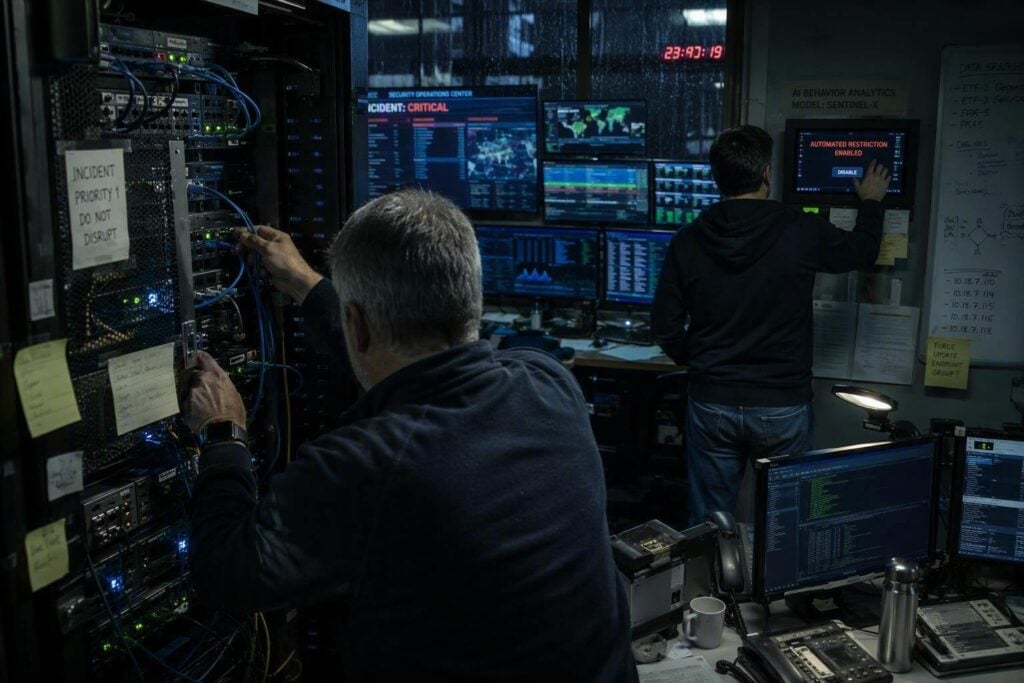
AI guardrails in security operations centres (SOCs) are widely touted as essential for responsible automation. However, research from Cisco Talos reveals that poorly implemented or externally controlled AI guardrails can actually undermine defenders and may even benefit attackers. This development has critical implications for organisations relying on AI-driven tools for incident response and threat hunting.
How AI Guardrails Can Backfire in SOC Operations
On 27 August 2026, Cisco Talos released a detailed analysis exploring the unintended consequences of default or provider-controlled AI guardrails in SOC environments. The concern centres around the increasing adoption of AI-powered security tools, where guardrails are meant to prevent misuse or risky actions. While these controls are intended to protect organisations from accidental data exposure or unsafe automation, they may also introduce new risks.
According to Cisco Talos, when AI guardrails are set and managed by external vendors rather than in-house security teams, they can create operational blind spots. If an attacker is aware of these limitations, they may exploit the predictable refusals or slowdowns in automated processes to their advantage. For instance, if a security agent or AI system encounters a pre-set restriction and responds with “Sorry, I can’t help with that,” this could delay or block critical investigations, giving adversaries a window to escalate their activities undetected.
Key Findings from Cisco Talos
- AI guardrails managed by external providers can introduce rigid constraints that interfere with live incident response.
- Automated refusals in agentic SOC processes may slow or halt investigations, allowing attackers additional time to operate.
- Defenders lose operational sovereignty when they cannot tune or override AI controls in response to emerging threats.
- Customisation and rapid override capabilities are essential for effective SOC operations, especially during active attacks.
This research challenges the prevailing view that more AI safety is always better. Instead, it demonstrates that inflexible or opaque guardrails can erode the defender’s crucial advantage: the ability to detect and respond faster than an attacker can adapt.
Detailed Timeline and Scope of the AI Guardrail Risk
The issue has gained urgency in 2026 as more organisations deploy generative AI and agentic automation in their security tooling. Cisco Talos’s findings stem from real-world observations of SOC processes, particularly during high-stakes incident response. The timeline below summarises key developments:
- In recent years: Significant uptake of AI-driven SOC tools, often with provider-controlled safety filters.
- Recently: Reports of investigations being delayed or blocked by automated refusals, often using default guardrail policies.
- Recently: Cisco Talos analyses multiple cases where operational sovereignty was lost due to inflexible guardrails, highlighting adversarial use of these constraints.
- 27 August 2026: Publication of a comprehensive Cisco Talos blog post, warning that poorly placed guardrails can act as a “force multiplier” for attackers if not properly managed by the defending organisation.
Importantly, the risks described are not tied to a specific AI product or vendor, but rather to the widespread practice of outsourcing AI safety control to third parties. Any organisation using AI tools in its SOC, regardless of platform, could be affected if guardrail policies are not internally governed and adaptable.
How Attackers Could Exploit Guardrail Limitations
Cisco Talos notes that adversaries may deliberately craft attack paths that exploit the known boundaries of AI guardrails. For example, if an attacker understands that certain types of file access, command execution, or investigative queries will trigger an automated refusal, they can structure their actions to avoid detection or to create confusion within the SOC. Each time a guardrail blocks a legitimate investigation step, it provides the attacker with additional time to achieve persistence, escalate privileges, or exfiltrate data.
Furthermore, when escalation is required for a human override, the delay could be enough for the attacker to cover their tracks or execute their final stage. This risk is compounded if the SOC team does not have the ability to quickly bypass or adjust these controls in real-time.
Why AI Guardrail Control Matters for Security Teams
The heart of the issue is operational sovereignty. Cisco Talos argues that defenders must retain direct control over their AI guardrails, ensuring they are tailored to the organisation’s unique threat model and investigative needs. Without this, the defender’s advantage of speed and adaptability is lost, and the attacker gains a new opportunity to evade detection.
- AI guardrails should be customisable and context-aware, not one-size-fits-all.
- Organisations must be able to override or modify guardrails rapidly during live incidents.
- Reliance on third-party policies introduces unacceptable risk in high-stakes scenarios.
Talos’s research highlights that the placement and management of AI guardrails is as important as their substance. Controls should reside within the organisation’s own infrastructure, with policies and technical mechanisms for authorised exceptions clearly defined and tested.
Actions for Organisations Using AI in Their SOCs
In light of Cisco Talos’s findings, organisations should:
- Review AI-powered SOC tools to ensure guardrails are under local control and can be overridden during incidents.
- Work with vendors to understand exactly how safety filters operate and what options exist for customisation.
- Regularly test incident response processes that involve AI tools, including scenarios where guardrails could impede investigations.
By taking these steps, organisations can minimise the risk of AI guardrails inadvertently aiding attackers and maintain the defender’s edge in speed and adaptability.
Originally reported by blog.talosintelligence.com.

