





A ClickFix attack placed 13 separate malicious traps on a single compromised WordPress site. The lures attempted to persuade Windows and macOS visitors to paste and execute attacker-controlled commands copied to the clipboard by malicious scripts.
Published on 19 November 2026, the investigation found three competing malware kits on academicpipelinedatabase[.]net. Researchers also identified seven additional loaders that did not complete during the observed scan, showing how repeatedly compromised websites can accumulate several unrelated infections.
How the ClickFix attack was discovered
The urlscan Threat Research Team uncovered the incident during routine research involving a feature that captures clipboard activity during live browsing. A scan of academicpipelinedatabase[.]net carried a ClickFix classification, despite initially appearing not to write anything to the clipboard.
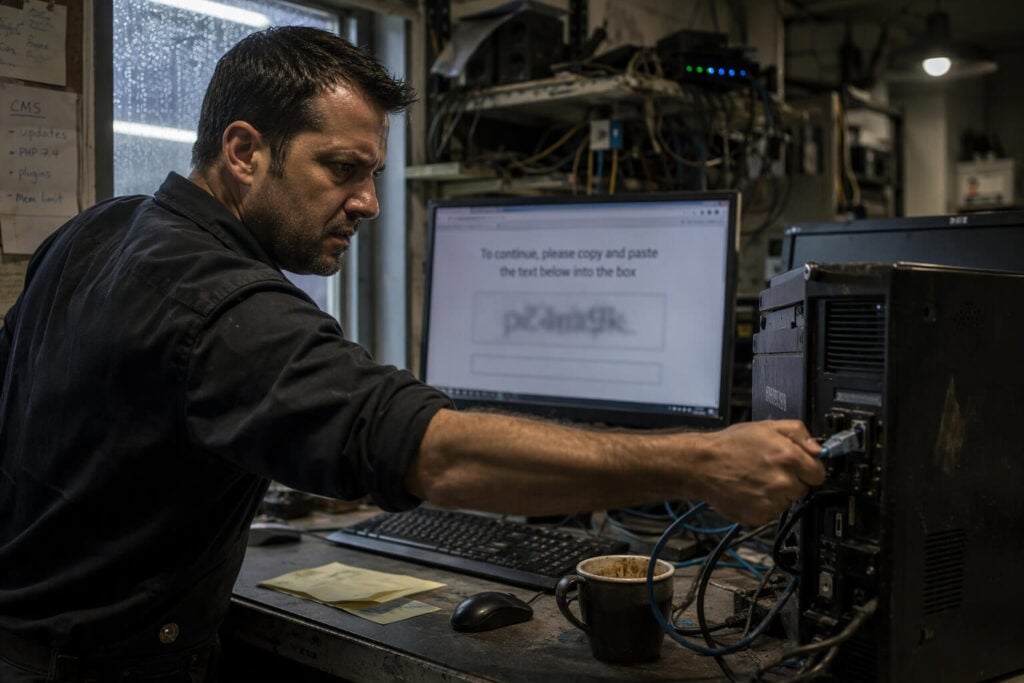
Closer analysis revealed a fake reCAPTCHA box displayed over a blurred Cloudflare-style page. The compromised page contained more than 20 hidden or obfuscated script blocks, including 13 ClickFix injections attributed to three kits.
Five of the injections used EtherHiding, a technique that retrieves infrastructure details from smart contracts on the Polygon blockchain. Several scripts also tried to suppress or remove competing malware from the page.
The findings were summarised by multiple security publications on 23 November 2026. However, the primary technical evidence comes from the 19 November investigation, and no independent replication of the exact injection count has been reported.
How the ClickFix attack tricks visitors
ClickFix is a social engineering technique rather than the exploitation of a browser vulnerability. A website presents a fake verification process, usually resembling reCAPTCHA, Cloudflare or another familiar security service.
When the visitor interacts with the prompt, JavaScript silently places an operating system command on the clipboard. Instructions then tell the visitor to open a terminal or Run dialogue, paste the command and execute it to complete the supposed verification.
This approach can bypass some browser and download protections because the victim initiates the command outside the browser. A legitimate CAPTCHA or Cloudflare verification page will not ask a visitor to paste PowerShell, shell or terminal commands.
Nine injections from the LOM kit
The largest component of this ClickFix attack was a kit researchers called LOM, named after the “/lom” path in its URLs. LOM accounted for nine of the 13 injections and used individual tracking tokens and operating system-specific commands.
On Windows, recovered commands used PowerShell to fetch and execute a script from attacker infrastructure. Requests included matching WUA user-agent and X-WUA header values, apparently allowing the server to distinguish genuine lure traffic from direct investigation.
One LOM variant also contained a macOS path that downloaded a shell script and piped it into zsh. The observed LOM delivery methods included:
- Scripts inserted directly into the compromised page.
- Base64-packed scripts intended to conceal their purpose.
- External script tags disguised as WordPress plugins, including the name “wordpress-defender”.
- A loader using browser blob functionality.
- EtherHiding loaders reading infrastructure from Polygon contracts.
The LOM EtherHiding contract was first observed in urlscan data during the week beginning 21 September 2026. More than 700 additional affected sites appeared in the following week, indicating rapid campaign growth.
Cloudflare and macOS kits found on the site
Fake Cloudflare verification and Windows persistence
The second kit in the ClickFix attack displayed a fake Cloudflare CAPTCHA. Three of its loaders queried Polygon contracts, decoded the returned data using base64 and XOR operations, and recovered hostnames and a JavaScript path. The code activated only when it detected a Windows browser.
Only one of these loaders delivered a working payload during the scan. Its PowerShell command launched headless execution through conhost, downloaded a ZIP archive and extracted it into a hidden folder named 638.
The malware then created persistence through the current user’s Windows Run key. The value was named “nurture_river_mountain”, causing the program to run again after reboot. A fake success message was printed to make the verification process appear legitimate.
One copy of this loader had also been appended to eight JavaScript files belonging to WordPress themes and plugins. Identified locations included files under the Brikk theme and the Routiz plugin, demonstrating file-level tampering rather than an infection confined to database content. Indicators associated with this kit overlap with the ErrTraffic ecosystem previously examined by SEKOIA and Censys.
A macOS-only injection
The third kit targeted macOS visitors. It masqueraded as a Google Analytics tag and displayed a reCAPTCHA-style overlay only to macOS user agents.
The copied command downloaded and executed a shell script, deleted that script afterwards and cleared the shell history to reduce visible traces. Researchers noted overlap with previously reported Macfinger activity. Infrastructure connected with this lure included reed-koaor-tekzr[.]pro and 45.147.31[.]197.
Competing malware disrupted the ClickFix attack
The scripts did not coexist cleanly. Some LOM variants searched for patterns associated with rival loaders and removed matching scripts. A separate overlay suppression script allowed the LOM and Cloudflare-style overlays to remain while deleting others.
Competition also caused operational errors. Two EtherHiding loaders used the same function name for decoding data, and one overwrote the other. This naming collision prevented one loader from working correctly.
This interference suggests that different operators compromised the WordPress site at different times. It also shows why counting only the currently visible lure may underestimate the scale of a website infection.
Affected systems and current exploitation status
The ClickFix attack was active in the wild, not a proof of concept. At least one complete Windows payload chain worked at the time of analysis, while other injections displayed active lures or attempted to retrieve further stages.
No vulnerable WordPress core version, plugin flaw or CVE was identified as the original entry point. The report therefore does not establish that any particular WordPress release is vulnerable. The affected endpoints were Windows systems with PowerShell and macOS systems with zsh, but execution still depended on a visitor following the fraudulent instructions.
Actions for WordPress operators and users
Owners of potentially affected WordPress sites should inspect files as well as database records. Reinstalling trusted copies of core files, themes and plugins may be necessary where JavaScript has been modified on disk.
- Review file changes under wp-content, especially theme and plugin JavaScript files.
- Search logs and security tools for the identified domains, Polygon contract activity and the “nurture_river_mountain” Run value.
- Remove unauthorised code, update WordPress components and rotate administrative, hosting and file transfer credentials.
- Investigate endpoints where users pasted PowerShell or zsh commands after seeing a website verification prompt.
This ClickFix attack demonstrates that cleaning a visible overlay alone may leave additional loaders behind. Site operators should establish how access was obtained and verify file integrity before returning an affected website to service.
Originally reported by cybersecuritynews.com.


