



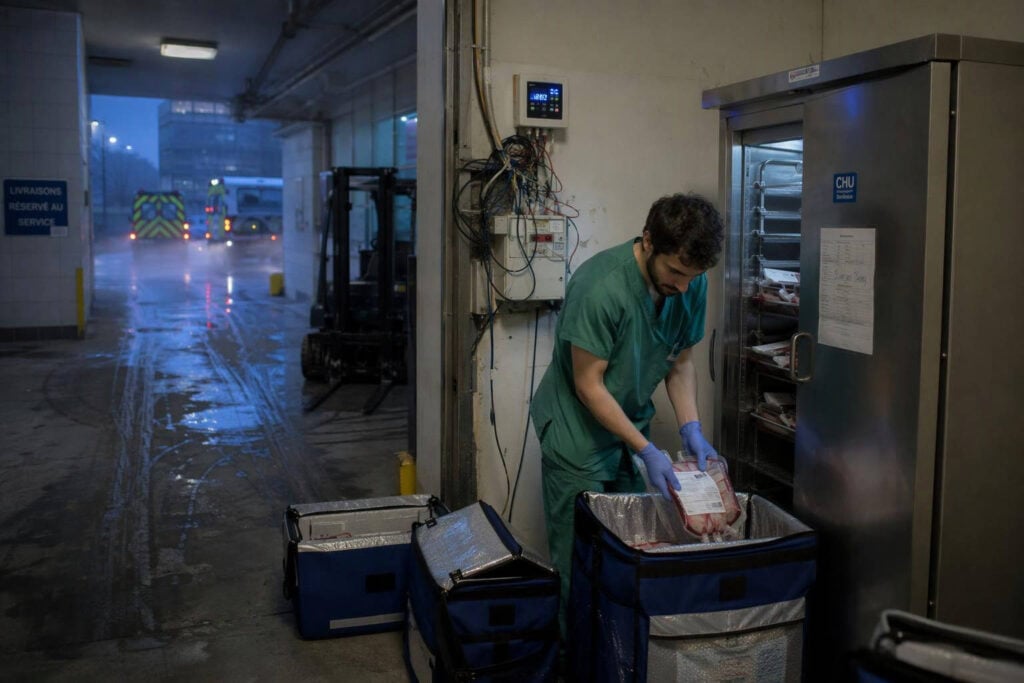


The EFS refrigerator hack maliciously changed cold-room settings at three French blood storage sites. Automated alarms and rapid staff intervention prevented blood products from being lost or causing a health impact.
The incident, which occurred overnight from 1 to 2 November 2026, affected refrigeration supervision and control installations supplied by an external provider to the French Blood Establishment, known as Etablissement francais du sang or EFS. It demonstrates how access to connected industrial equipment can be used to interfere directly with safety-critical physical processes.
What happened in the EFS refrigerator hack
EFS confirmed that its refrigeration equipment provider experienced a cybersecurity incident affecting installations deployed at three EFS sites. The attackers altered configuration parameters controlling cold-room temperatures and defrost cycles, setting them to very high values.
The malicious changes were detected by EFS alarm and monitoring systems. On-call teams responded by neutralising affected equipment or moving blood products into safe storage, depending on the conditions at each location.
EFS said these measures prevented the loss of any blood products. The organisation and the French health ministry also reported that no health impact had been identified.
The national EFS statement did not name the refrigeration provider. Multiple media reports identified the company as Coolworld, but that identification had not been included in the official EFS confirmation as of 4 November 2026.
Extreme temperature settings reported
EFS stated that both temperature and defrost thresholds were changed to very high values. It did not publish the precise settings or disclose how long the altered configurations remained active.
Regional comments and media reports suggested that target settings were pushed to approximately 110 to 115 degrees. Some affected cold rooms normally operate at around minus 25 degrees for plasma storage. These numerical claims were not confirmed in the national EFS statement, so they should be treated as reported details rather than established technical findings.
The physical temperature of a cold room does not change instantly when its target setting is altered. This delay, combined with alarms and staff intervention, appears to have provided enough time to protect the stored products. The incident nevertheless involved a genuine attempt to manipulate operational conditions, rather than simply steal information or disrupt an office network.
EFS refrigerator hack timeline and response
The EFS refrigerator hack followed a separate wave of compromises involving supermarket refrigeration equipment in France. Although both events involved connected cooling systems, no official finding has established that the same attackers, infrastructure or access method were responsible.
- 11 to 12 October 2026: A wave of compromises affects internet-connected supermarket refrigeration controllers in France.
- 12 October 2026: CERT-FR publishes alert CERTFR-2026-ALE-012 about numerous compromised refrigeration management systems.
- 13 October 2026: CERT-FR updates its alert and continues to warn about exposed and insufficiently secured interfaces.
- Overnight 1 to 2 November 2026: Systems belonging to an EFS refrigeration provider are compromised, and cold-room parameters at three sites are altered.
- 2 November 2026: Alarms trigger, allowing staff to isolate equipment or transfer stock before blood products are lost.
- 3 November 2026: EFS publicly confirms the incident, its response and the absence of any identified health impact.
- 4 November 2026: Wider reporting provides further detail, including the media identification of Coolworld and claims about extreme temperature settings.
EFS said it had secured the affected equipment, reinforced monitoring across its installations and taken preventive action to protect products. The French national cybersecurity agency ANSSI and the health ministry were engaged in the response.
No threat actor had been publicly identified by 4 November 2026. There were also no published indicators of compromise, such as malicious IP addresses, domains, file hashes or account names, that other refrigeration operators could use for threat hunting.
How the refrigeration systems were compromised
The confirmed information describes a compromise of a provider’s supervision and control installations, followed by unauthorised changes to temperature and defrost settings. EFS and ANSSI had not disclosed the initial access route, authentication method or specific software involved.
No vulnerability identifier, proof of concept or individual software flaw has been linked to the EFS refrigerator hack. It is therefore not possible to say whether the attackers exploited vulnerable firmware, reused credentials, abused a remote support account or entered through another part of the provider’s environment.
Affected products and versions remain unconfirmed
EFS has not identified any product family, controller model, firmware release or software version used at the three sites. Organisations should not assume that a particular refrigeration platform was involved merely because other products were targeted during the October activity.
In its alert about that separate campaign, CERT-FR named Danfoss AK-SM and AK-SC series systems, as well as Copeland xweb and Dixell xweb supervisory platforms. The agency highlighted management interfaces that were directly accessible from the internet and insufficiently hardened. However, no official source has connected those products to the EFS event.
The distinction matters because this was not presented as a single-vulnerability incident with a universal patch. The known attack behaviour involved obtaining access to operational controls and using legitimate configuration functions to create unsafe settings.
Why the EFS refrigerator hack matters
The incident shows that a compromise of a technology supplier can cross into a customer’s physical operations. An attacker able to control refrigeration settings can potentially spoil blood, plasma, medicines, food, laboratory samples or other temperature-sensitive materials without deploying destructive malware on the customer’s main network.
It also shows the value of independent safeguards. EFS did not rely solely on the provider’s control platform: alarms, monitoring, on-call staff and alternative storage allowed it to detect the changes and respond before supplies were lost.
For UK organisations using networked refrigeration or building management systems, the relevant exposure may sit with a maintenance company or remote support platform. Responsibility for reviewing that access should not be assumed to rest entirely with the equipment provider.
Actions for organisations using connected cooling
Operators should first establish whether refrigeration controllers, supervisors or vendor support services are directly reachable from the internet. CERT-FR’s guidance for the active refrigeration compromises provides a focused set of measures:
- Remove direct internet exposure from management interfaces.
- Require remote connections through a VPN or tightly filtered trusted IP addresses.
- Replace default or weak passwords and review provider access accounts.
- Apply current firmware and security configuration updates.
- Check temperature setpoints, defrost schedules and recent configuration changes.
- Test independent alarms and confirm that staff can move stock or isolate equipment quickly.
Organisations should also ask providers to explain how remote access is logged, protected and disabled when not required. As the EFS refrigerator hack illustrates, resilient monitoring and a rehearsed operational response can determine whether malicious configuration changes become a costly physical loss.
Originally reported by Nacionale.

