






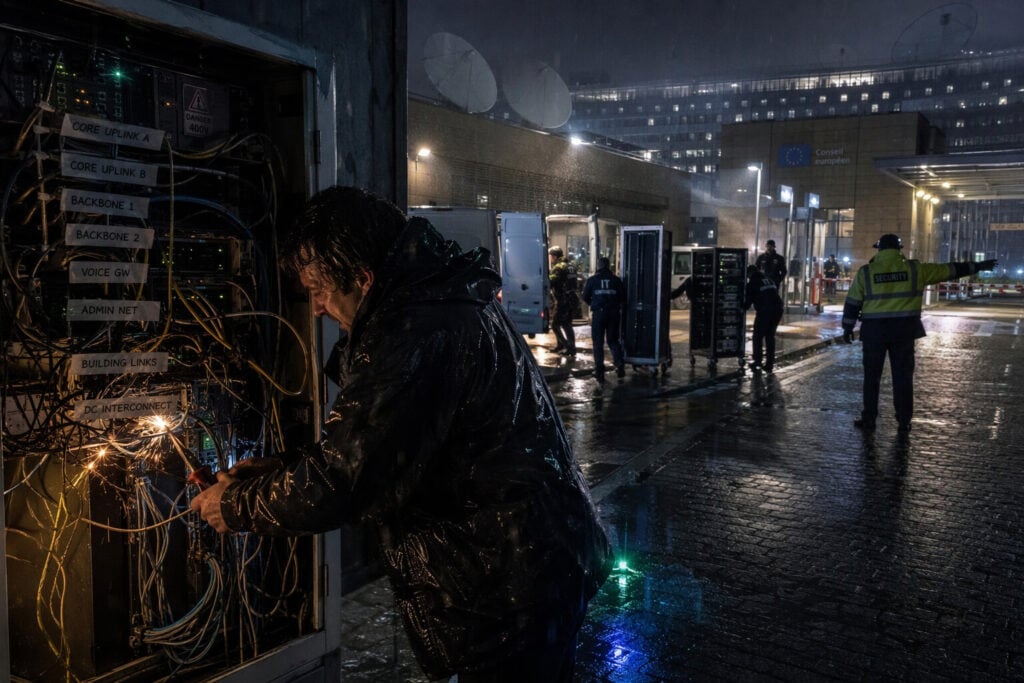
The European Commission cyberattack disrupted several internal applications after being detected on 22 October 2026. Officials confirmed on 19 November 2026 that AI-based tools were used in the campaign.
The incident affected routine but important business systems, including human resources, medical reimbursement and translation services. Several applications were taken offline as a precaution, most were later restored, and the investigation remains ongoing.
European Commission cyberattack: What happened?
The European Commission said it had been targeted by an AI-generated cyber campaign. The incident was detected on 22 October 2026, although it did not become public until reports emerged on the morning of 19 November.
The Commission then confirmed the attack at a press briefing on 19 November. It said several applications had been temporarily taken offline to contain potential risks and allow technical checks to take place. Most of those applications were subsequently restored.
Initial reports described disruption lasting for more than 10 days during early and mid-November. The affected applications were internal Commission services rather than public-facing EU websites.
The European Commission cyberattack primarily affected the following systems:
- Sysper, the Commission’s HR platform for payslips, timesheets and leave requests. It was restored but reportedly crashed briefly again on 18 November.
- Medical reimbursement services, identified in reports as MyPMO and the Joint Sickness Insurance Scheme. The scheme was reportedly still unavailable on 19 November.
- Translation services, which experienced disruption on 17 November.
No public version numbers, external technology suppliers or underlying platform details have been disclosed. The Commission has also not identified a specific software vulnerability, CVE or initial access route connected to the incident.
Timeline of the AI-assisted attack
Detection and investigation
The Commission’s stated detection date is 22 October 2026. Public accounts differ slightly over when the attack was formally confirmed internally. One account says it was confirmed on 22 October, while another places confirmation on 26 October following an initial investigation.
That difference does not change the established detection date. It does, however, show that some aspects of the response timeline have not yet been fully clarified in public statements.
Operational disruption
During early and mid-November, multiple applications were removed from service while teams investigated and checked the affected environments. The outages continued for more than 10 days, according to officials and internal communications cited in public reporting.
Sysper and the medical reimbursement platform were restored earlier in the week of 19 November, although Sysper reportedly suffered another brief failure on 18 November. Two officials also indicated that the Joint Sickness Insurance Scheme remained unavailable the following day.
The incident was discussed at the College of Commissioners’ weekly meeting on 18 November. European Commissioner Henna Virkkunen briefed other commissioners on the situation.
Public confirmation
The European Commission cyberattack was first reported publicly at 06:26 CET on 19 November. The Commission confirmed the core details later that day, including the use of AI tools, the precautionary application shutdowns and the 22 October detection date.
CERT-EU, which supports EU institutions in responding to cyber threats, was involved in the investigation. The European Data Protection Supervisor was also notified.
How ARTEX was reportedly used
Reporting about the European Commission cyberattack identified ARTEX as the framework used by the attackers. ARTEX is a publicly available, AI-powered penetration-testing platform that can automate parts of reconnaissance, vulnerability discovery and exploitation.
ARTEX uses large language model technology and multiple software agents to test web applications and infrastructure. In legitimate security testing, this can help authorised teams find weaknesses more quickly. Threat actors can repurpose the same capabilities to scan targets, identify exposed services and attempt to combine several weaknesses into an attack path.
CERT-EU has warned that malicious actors have actively used ARTEX in recent weeks. The FBI also published a technical notice on 13 November 2026 describing how the framework can rapidly chain techniques across cloud services and web applications, potentially reducing the time needed to obtain privileged access to hours.
These broader descriptions explain the capabilities associated with ARTEX, but they should not be treated as confirmed details of the Commission incident. No Commission-specific entry point, exploit chain or attacker infrastructure has been made public.
The confirmed details are more limited: AI-based tools were used, individual internal systems were targeted, several applications were taken offline, and ARTEX was identified in reporting and official comments about the attack.
Data exposure and current exploitation status
The incident represents confirmed malicious use of AI-assisted attack tooling in the wild. However, the Commission has not attributed the activity to a country, criminal group or other threat actor.
There was no ransom demand. The Commission also said there was no evidence, at the time of its 19 November briefing, of a data breach affecting Commission staff as a whole.
Earlier reporting suggested that substantial quantities of personal information might have been compromised. That claim has not been publicly confirmed, and it differs from the Commission’s on-record position. The absence of evidence at this stage does not establish that no individual records were accessed, so the ongoing investigation remains important.
No Commission-specific indicators of compromise have been published. General ARTEX-related indicators released by authorities relate to other observed campaigns and should not automatically be blocked or treated as proof of compromise without local validation.
Why the European Commission cyberattack matters
The event demonstrates how AI-assisted frameworks can be directed at everyday organisational systems, not only classified networks or specialist infrastructure. HR, reimbursement and translation platforms can hold sensitive information while also supporting essential daily operations.
Automated tooling allows attackers to test internet-facing applications, cloud identities and configuration weaknesses at speed. Organisations dependent on a small number of staff portals or third-party integrations may therefore face significant disruption even when data theft or ransomware is not confirmed.
Actions organisations should take now
Organisations with internet-facing staff portals, cloud services or older web applications should use the European Commission cyberattack as a prompt for targeted checks. Priority actions include:
- Identify and patch exposed web applications, especially systems handling HR, payroll, expenses or medical information.
- Remove management interfaces from public access and enforce multi-factor authentication for administrative and cloud accounts.
- Review web application firewall, identity and application logs for rapid automated scanning, repeated exploitation attempts and unusual privilege changes.
- Validate ARTEX-related indicators against internal telemetry before blocking infrastructure or escalating an incident.
- Confirm that critical staff applications can be isolated and restored without causing prolonged operational disruption.
These steps directly address the automated reconnaissance, web application testing and cloud identity risks associated with ARTEX-style activity while further details of the Commission investigation are awaited.
Originally reported by AOL.com.

