






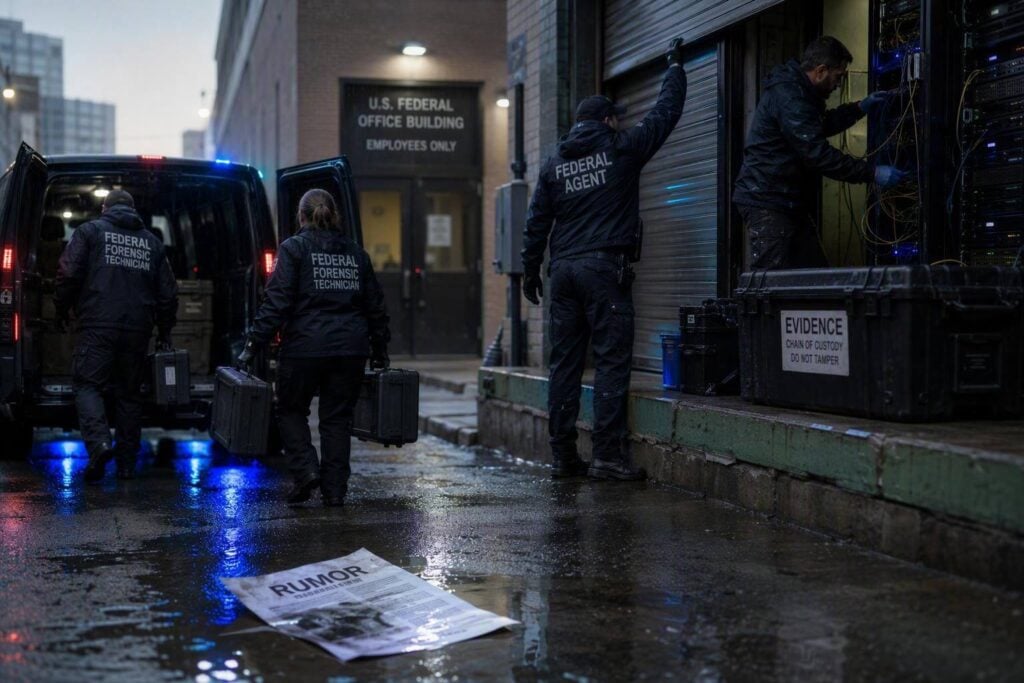
The ShinyHunters FBI claim published on 22 September 2026 alleges a serious compromise of agency data and services. However, the post supplies no files, screenshots, data samples or other evidence that would allow the allegations to be verified.
The listing should therefore be treated as an unconfirmed threat actor statement, not proof that the Federal Bureau of Investigation has suffered a breach. The source carrying the listing also warns that claims attributed to ShinyHunters have previously been reported as unverified or fabricated.
What the ShinyHunters FBI claim alleges
ShinyHunters published a leak-site entry titled “PSA – READ THIS NOW” on 22 September 2026. Rather than naming a conventional commercial victim, the post presents a public statement directed at the FBI.
The group claims it compromised the agency after what it describes as false allegations in an FBI FLASH report from the second quarter of 2026. The source material does not identify the exact report, reproduce its findings or provide technical indicators linking that report to the subsequent claim.
According to the listing, the attackers obtained sensitive information relating to nearly all FBI agents. They also claim access to information about people who applied for employment with the agency, including candidates for Special Agent and other positions.
The ShinyHunters FBI claim further names several services or organisational functions as allegedly affected:
- Criminal Justice services
- Human Resources services
- Medlink
- Records concerning FBI personnel
- Employment application information
These are assertions made by the group. The listing does not explain whether the named services were directly breached, merely accessed through a connected account, disrupted, or referenced in supposedly stolen records.
No affected products or versions identified
This is not a disclosed software vulnerability with known affected products, version ranges or security patches. The post names no operating system, application, cloud platform, supplier, vulnerability identifier or exploitation method.
It also provides no initial access details. There is no claim involving phishing, stolen credentials, malware, an exposed service, a software flaw or exploitation of a third-party provider. Consequently, no technical route into an FBI environment can be established from the listing.
Evidence missing from the ShinyHunters FBI claim
The most important feature of the post is the lack of substantiation. No allegedly stolen records are available for independent examination, and the group has not published even a limited sample that might demonstrate possession of genuine FBI information.
The listing contains no screenshots, archive listings, database structures or redacted documents. It also gives no volume for the allegedly stolen data, no number of affected individuals and no description of particular personal data fields.
There are no download links or supporting files. The source carrying the post states that it did not obtain, host, view or redistribute stolen information, and describes its entry as an automated and redacted record scraped from the group’s Tor leak site.
The ShinyHunters FBI claim also lacks independent confirmation. The supplied material contains no FBI statement acknowledging a compromise, no corroboration from another authority and no technical findings from an incident response investigation.
No ransom or payment demand
Although the entry appears in the context of a ransomware leak site, the group explicitly presents it as a public statement rather than a financially motivated extortion attempt. ShinyHunters says it is not requesting a ransom or other payment.
No cryptocurrency address, negotiation channel, ransom amount or payment deadline is included. There is also no encryption claim, evidence of operational disruption or indication that systems were locked. Calling the entry a ransomware victim listing does not establish that ransomware was deployed.
Timeline and current exploitation status
The only confirmed event date in the supplied material is 22 September 2026, when the leak-site post was published. The alleged date of initial access, duration of access and time of any claimed data extraction are not specified.
The post gives the FBI one week to remove or correct the referenced report. If measured from publication, that period would end on 29 September 2026. The group warns that it may respond further if officials or journalists continue making statements it considers defamatory, but it does not clearly define what that response would involve.
The mirrored page also displays an update date of 23 September 2026. As that date is later than both the stated publication date and today’s date of 22 September 2026, it cannot presently be treated as evidence of a later development.
There is no confirmed exploitation status because no exploited vulnerability or compromised system has been identified. It is not currently possible to establish whether the group has access, previously had access, obtained information from another source, or fabricated the ShinyHunters FBI claim.
Why this unverified claim still matters
Claims involving law enforcement personnel and applicants can attract rapid attention even when evidence is absent. Repeating the allegation as an established breach could amplify the group’s narrative, create unnecessary concern among potentially affected people and make later correction difficult.
The reference to agent and applicant information could also be used to make unrelated phishing messages or fraudulent data offers appear credible. That possibility does not prove the underlying claim, but it makes accurate language and careful verification particularly important.
How organisations should respond
Security teams should record the ShinyHunters FBI claim as unverified intelligence and monitor for credible updates from the FBI or other authoritative sources. Decisions should be based on corroborated evidence rather than the presence of an organisation’s name on a criminal leak site.
- Do not download purported samples from unknown accounts or untrusted file-sharing services.
- Preserve any related phishing messages, fraudulent data offers or impersonation attempts for investigation.
- Check whether new evidence includes verifiable records, technical indicators or an official acknowledgement.
- Describe the event internally as an allegation unless independent confirmation emerges.
For now, the available evidence supports only one conclusion: ShinyHunters published the statement on 22 September 2026. Its wider claims about FBI systems, personnel and applicant data remain unsupported.
Originally reported by redpacketsecurity.com.


