



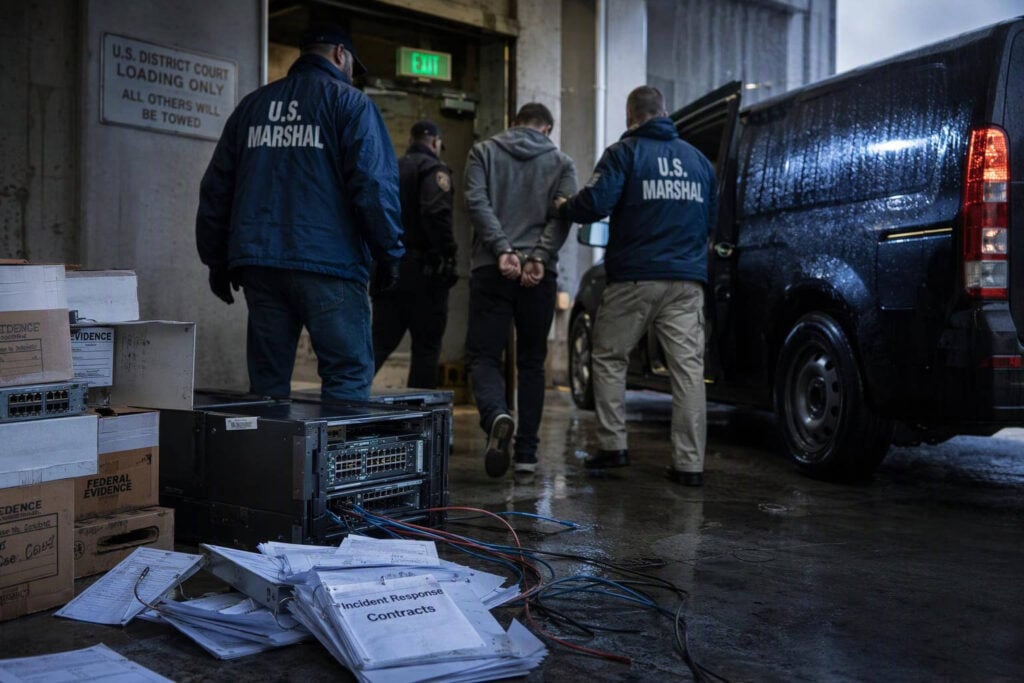


The Edward Dubrovsky arrest has brought new attention to the relationship between cyber extortion groups and professional ransomware negotiation services. Federal agents detained the Canadian cybersecurity executive in Pennsylvania on 8 October 2026.
Media reports connect the case to the FBI’s investigation into ShinyHunters, a prolific extortion group. However, the criminal complaint remains sealed, and the public court record does not yet establish that Dubrovsky was involved in any specific ShinyHunters incident.
What the Edward Dubrovsky arrest involves
Federal court records identify the defendant as Edward Dobrovsky, while media reporting and professional profiles use the spelling Edward Dubrovsky. He is a 54-year-old Canadian cybersecurity executive associated with companies that provide ransomware negotiation and cyber extortion response services.
The Eastern District of Pennsylvania docket for United States v. DOBROVSKY records his arrest on 8 October. He was arrested under Rule 40, the procedure used when a person is detained in a district other than the one where charges originated.
Dubrovsky appeared before Magistrate Judge Scott W. Reid in Pennsylvania. The court ordered him detained, and on 9 October he was committed to the Eastern District of Texas, where media reports indicate the FBI has centralised parts of its ShinyHunters investigation.
The Edward Dubrovsky arrest was first reported publicly on 9 October. Initial reports described an unnamed Canadian suspect arrested in Pennsylvania in connection with the ShinyHunters inquiry. Subsequent reporting identified Dubrovsky through federal court records and other publicly available information.
Cybersecurity and ransomware negotiation background
Dubrovsky has been associated with Canadian cybersecurity businesses specialising in ransomware response and negotiation. He co-founded Cypfer and has more recently been linked to CyberSteward, another firm offering cyber extortion advisory and settlement services.
Reporting indicates that he was in Pennsylvania around the time of the Cyber Risk Summit, held at the Loews Philadelphia Hotel from 5 to 7 October. Cypfer was listed as a major sponsor of the event, and Dubrovsky had previously posted that he intended to attend with the CyberSteward team.
Attendance at the conference is contextual information and is not evidence of the alleged offences. The sealed complaint is expected to contain the factual allegations supporting the charges, but it was not publicly available as of 10 October.
Charges behind the Edward Dubrovsky arrest
Available docket indexes and reports based on court records describe two central allegations. These are conspiracy to threaten to impair the confidentiality of information with the intent to extort money, and interference with commerce by threats.
- Conspiracy involving threats against the confidentiality of information for financial gain.
- Interference with interstate commerce through threats or extortion.
- Alleged use of stolen or hacked data as leverage to demand payment.
These formulations suggest an alleged scheme based on threatening to disclose information, or otherwise using control of confidential data to obtain money. They do not reveal which organisations were allegedly affected, what communications took place, how much money was demanded, or what role the defendant is accused of performing.
No public indictment or unsealed factual narrative was available on 10 October. The Edward Dubrovsky arrest therefore represents an early stage in the criminal process, and the allegations have not been tested in court.
Reported ShinyHunters connection
FBI Director Kash Patel publicly referred to the arrest of another suspected ShinyHunters co-conspirator during the week of 5 October. Multiple reports have identified the Canadian suspect detained in Pennsylvania as part of that wider investigation.
ShinyHunters is described by the FBI as a prolific cyber extortion operation. In an FBI video posted on 28 September 2026, the bureau alleged that the group had breached more than 140 organisations and received at least 70 million US dollars in extortion payments since the previous year.
The broader investigation has produced other law enforcement activity. Dutch authorities arrested Pepijn van der Stap on 28 September in a related ShinyHunters investigation. The Edward Dubrovsky arrest followed less than two weeks later.
Despite this context, the distinction between confirmed court information and reported connections is important. Publicly accessible filings do not yet say that Dubrovsky participated in ShinyHunters, nor do they directly connect his charges to the recent compromise of the FBI’s recruitment platform.
Timeline and the FBI jobs portal breach
The investigation follows a September 2026 breach of the FBI jobs portal. ShinyHunters claimed responsibility, and reporting connected the compromise to a third party managed platform used by the bureau.
On 5 October, reports said the FBI had removed a contractor after reviewing the incident. Reporting based on unnamed sources identified the affected environment as an Oracle PeopleSoft platform managed by Accenture and said a security patch had been missed.
The FBI has not named Oracle PeopleSoft, Accenture or a specific product version in a public advisory concerning the arrest. Those details remain media sourced and are not part of the unsealed court record.
- September 2026: The FBI jobs portal breach becomes part of the reported ShinyHunters investigation.
- 28 September: Dutch authorities arrest a suspect in a related investigation.
- 5 October: Reports emerge that the FBI removed a contractor following its breach review.
- 8 October: Federal agents arrest Dobrovsky in Pennsylvania.
- 9 October: He is detained and committed to the Eastern District of Texas.
- 10 October: The complaint remains sealed, with no public indictment or detailed allegation narrative.
Current exploitation status and technical information
The Edward Dubrovsky arrest is a criminal enforcement event, not a new vulnerability disclosure. No affected software versions, proof of concept code or technical exploit chain has been released in connection with the charges.
Law enforcement has also published no related indicators of compromise. There are currently no arrest-specific domains, IP addresses, file hashes or host artefacts that security teams can use for threat hunting.
ShinyHunters activity is considered active in the wild based on the FBI’s description of the group’s scale and continuing enforcement action. Nevertheless, the precise conduct alleged against Dubrovsky cannot be assessed until further court documents become public.
Why the Edward Dubrovsky arrest matters
The case could increase scrutiny of companies that negotiate with ransomware and extortion groups. Such providers can occupy a sensitive position between victims, insurers, legal advisers, incident responders and criminals demanding payment.
For UK organisations, the cross-border nature of ransomware response is particularly relevant. A negotiator may operate from another country, communicate with threat actors elsewhere and handle information that may later become evidence in several jurisdictions.
What organisations should do now
Organisations do not need to patch systems because of this arrest, and there are no new technical indicators to deploy. The practical response is to review how external ransomware negotiators are selected, authorised and supervised.
- Confirm that negotiation providers document their legal authority, ethical standards and escalation procedures.
- Require clear records of communications, payment decisions and instructions given during an incident.
- Check that insurers, solicitors and incident response providers agree on vendor responsibilities before an emergency.
- Monitor the transferred Texas case for an unsealed complaint or indictment that clarifies the alleged conduct.
These steps should remain proportionate. The Edward Dubrovsky arrest concerns allegations against an individual and does not establish wrongdoing across the ransomware negotiation industry.
Originally reported by krebsonsecurity.com.


