



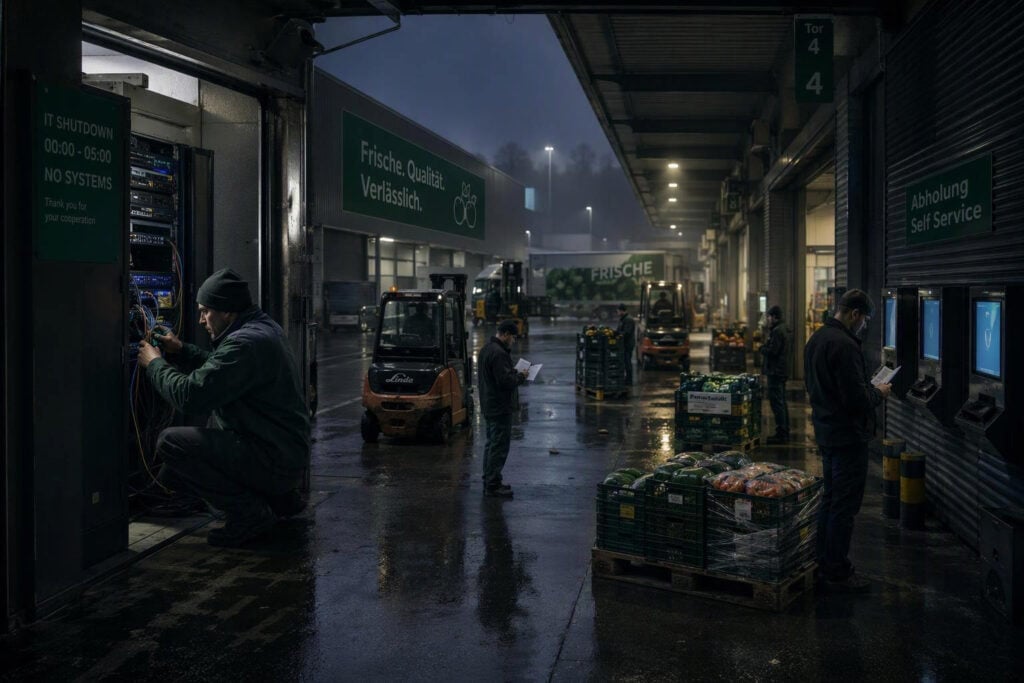


The Ahold Delhaize incident has disrupted websites, mobile apps, customer service and grocery deliveries across several retail brands. The group took some systems offline after identifying a security issue within its network.
Customer-facing problems began on the evening of 11 October 2026. By 12 October, Albert Heijn had cancelled all placed online grocery orders until further notice, while physical stores and tills remained operational.
Ahold Delhaize incident affects multiple retail brands
Ahold Delhaize, which is based in Zaandam in the Netherlands, publicly confirmed the security issue on 12 October 2026. It said teams were assessing the situation and had proactively taken some systems offline to protect the wider infrastructure.
The company described the shutdowns as precautionary measures. Its initial disclosure did not identify a threat actor, explain how access may have been obtained or specify which internal systems were affected.
The most detailed confirmed disruption concerned Albert Heijn. Its website and mobile app were unavailable, customer service systems were offline and online grocery deliveries were suspended. An update issued at 17:20 on 12 October confirmed that every placed online order had been cancelled until further notice.
Etos and Gall & Gall, which are also part of Ahold Delhaize, experienced unavailable websites, apps and customer service functions. The interruption therefore extended beyond a single supermarket platform and affected several customer-facing services connected to the wider group.
US retail trade reporting also found that websites operated by five Ahold Delhaize USA banners were unavailable at the time of reporting. These were:
- Food Lion
- The Giant Co.
- Giant Food
- Hannaford
- Stop & Shop
The available statements did not establish whether the US website outages had exactly the same technical cause. However, their timing placed them within the broader operational disruption affecting Ahold Delhaize brands.
Stores stayed open despite digital disruption
The Ahold Delhaize incident did not force the closure of physical stores. Albert Heijn confirmed that its tills continued to work and that national promotions were being applied at checkout.
Other connected retail functions were less resilient. Loyalty-linked personal discounts and certain savings programmes became unavailable. Electronic shelf labels could also show promotions from the previous week, creating a possible difference between the displayed shelf price and the current price applied at the till.
Albert Heijn warned that product availability could vary over the following days, especially for fresh produce, because of logistics constraints. Reports that work had stopped in several distribution centres had not been confirmed in the parent company’s official statement by 12 October.
Ahold Delhaize incident timeline
The sequence of public updates shows how an initially visible service outage developed into a confirmed network security investigation.
- On the evening of Sunday 11 October 2026, customer-facing services at Albert Heijn and sister brands began failing.
- At 03:18 on Monday 12 October, an early Dutch media report described unavailable websites and apps and identified the situation as a cybersecurity incident.
- At 07:44, further reporting said Albert Heijn, Etos and Gall & Gall websites, apps, customer service and deliveries were unavailable, although stores remained open.
- At 08:06, reports confirmed that the disruption had continued since Sunday evening and that customers could not place online orders.
- At 11:30, brand statements said several systems remained offline as a precaution while the investigation continued.
- On 12 October, Ahold Delhaize formally confirmed a security issue within its network and the protective shutdown of some systems.
- At 17:20, Albert Heijn confirmed the cancellation of all online orders, continuing digital outages and possible variation in product availability.
Ahold Delhaize flagged its corporate release as containing inside information under Article 7(1) of the EU Market Abuse Regulation. This reflects the potential significance of the disruption to the publicly listed business, but it does not provide further evidence about the cause.
What is known about the technical cause
The Ahold Delhaize incident was still active as of 12 October 2026, with several systems deliberately kept offline. The company’s description is consistent with containment during an intrusion investigation, where isolating systems can prevent further access or limit damage while responders establish what happened.
However, taking systems offline is not evidence that ransomware encrypted files. It also does not prove that attackers stole customer, employee or commercial information. No ransomware group, malware family, exploited vulnerability or initial access technique had been confirmed.
No indicators of compromise, such as malicious IP addresses, file hashes or domains, had been released by Ahold Delhaize or its brands. There was also no published proof of concept or technical advisory pointing to exploitation of a specific product.
Specific software versions and configurations have not been disclosed. The observed effects indicate disruption to e-commerce platforms, order management, customer service, loyalty functions and parts of logistics, while point-of-sale operations remained available. These effects help define the operational scope, but they do not reveal the root cause.
Ransomware and data theft remain unconfirmed
Some commentary characterised the event as a hack or suggested ransomware as a possible explanation. Those descriptions remain speculation unless supported by findings from Ahold Delhaize, law enforcement or another authoritative investigation.
As of the latest verified update on 12 October, the company had not confirmed ransomware, data exfiltration, attacker attribution or an intrusion vector. Customers should therefore avoid assuming that personal data has been compromised, while remaining alert for any subsequent notification from the affected brands.
Why the retail disruption matters
The incident demonstrates how containment can interrupt online retail even when stores and payment tills remain functional. Separately managed systems can produce sharply different outcomes, with checkout continuing while deliveries, apps, discounts, shelf labels and customer support become unavailable.
UK suppliers and logistics partners serving affected Dutch, Belgian or US operations could encounter cancelled orders, delayed fulfilment or inconsistent stock requirements. They should rely on confirmed communications from their commercial contacts rather than treating unavailable portals as evidence that an order remains active.
Actions for organisations and affected customers
Retailers should use the Ahold Delhaize incident to review whether e-commerce, loyalty and logistics platforms can be isolated without disabling core store operations. Incident plans should also define how cancelled orders, shelf price discrepancies and supplier communications will be managed during extended system shutdowns.
- Verify current orders through approved alternative channels if online portals are unavailable.
- Preserve relevant system and access logs if connected services show unusual activity.
- Avoid acting on unverified claims about ransomware or stolen data.
- Monitor official brand updates for service restoration or data exposure notices.
For customers, the immediate confirmed impact is service interruption rather than proven data compromise. The central unanswered questions remain how the security issue began, whether unauthorised access occurred and when the affected digital services will be restored.
Originally reported by cybersecuritynews.com.

