





A school cyber attack forced Queen Elizabeth School in Kirkby Lonsdale and its associated Studio School to close to pupils on 26 November 2026. The disruption followed a targeted phishing email sent shortly after 16:00 GMT the previous day.
Approximately 1,500 pupils were told to remain at home while the schools’ internal network and online systems were offline. At the time of reporting, the school said its backups were intact and scans had found no evidence that files had been accessed or deleted.
How the school cyber attack began
The incident started on Wednesday 25 November 2026, when the school’s senior designated safeguarding lead received an email impersonating an Egress secure-message notification. The email reportedly looked and behaved convincingly enough for a staff member to interact with it.
Monitoring systems subsequently generated an alert indicating a significant phishing attack. School leaders responded by shutting down the network as a precaution, isolating systems while the incident could be investigated and scanned for signs of unauthorised activity.
The executive headteacher described the approach as highly sophisticated and targeted. The school also said it believed the activity originated from outside the UK, although no threat actor, criminal group or country was publicly identified.
Egress branding was impersonated
The phishing message copied the appearance of an Egress secure email message. Egress provides secure email and anti-phishing services, but there was no report of a vulnerability or security flaw in an Egress product.
This distinction is important. The attackers appear to have relied on brand impersonation and social engineering rather than exploiting a disclosed software vulnerability. By presenting the message as a trusted secure communication, they attempted to persuade the recipient to take an action before recognising the deception.
No affected Egress product versions were identified because the incident was not reported as an attack against Egress software. Public statements also did not name the school’s email platform, operating systems, network products or other applications.
Why Queen Elizabeth School closed its sites
The immediate impact of the school cyber attack came from the defensive network shutdown rather than confirmed destruction or theft of data. Taking systems offline restricted access to information required for safe day-to-day operation.
The school said that student registration, safeguarding information and medical records could be unavailable while the network remained isolated. Contact details and other online resources used by staff were also affected. Leaders therefore decided that opening without reliable access to these systems could create unacceptable operational and safety problems.
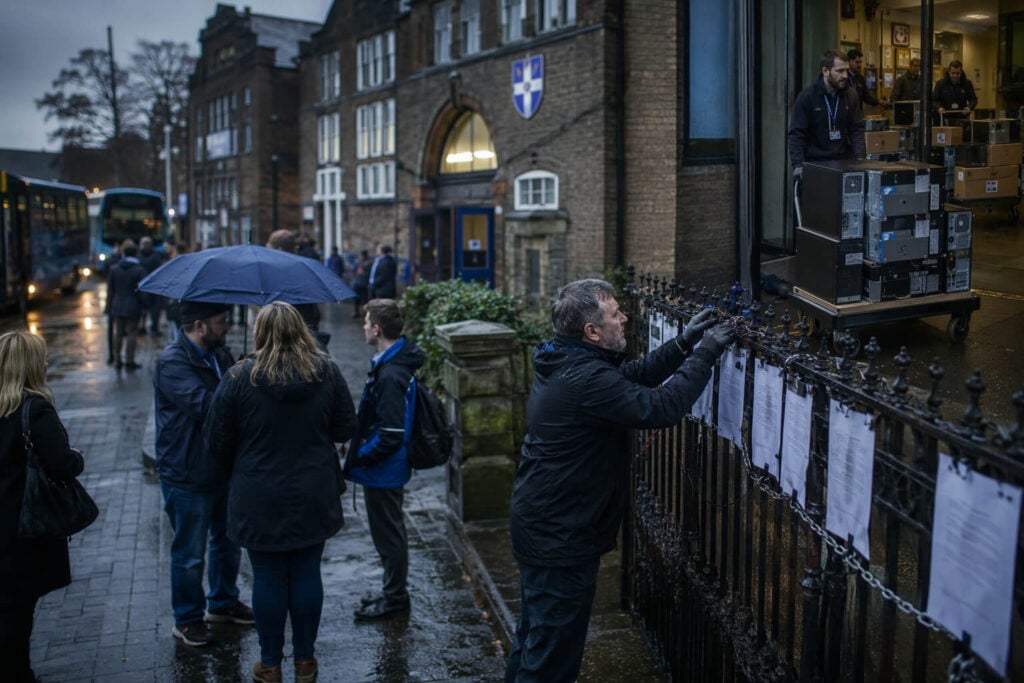
Queen Elizabeth School and its associated Studio School remained closed throughout Thursday 26 November 2026. About 1,500 pupils were instructed to stay at home for the day while technical checks continued.
The closure illustrates how phishing can interrupt an organisation even when there is no confirmed data breach. A precautionary response may be necessary to contain a possible intrusion, but isolating central systems can also prevent staff from accessing the records and services needed to operate.
Known timeline of the incident
-
Shortly after 16:00 GMT on 25 November 2026, a targeted phishing email was sent to the school’s senior designated safeguarding lead.
-
A staff member interacted with the message, which impersonated an Egress secure-message notification.
-
The school’s monitoring detected the suspected attack, prompting leaders to shut down the network as a precaution.
-
On 26 November 2026, Queen Elizabeth School and the associated Studio School closed to pupils while systems remained offline.
-
The school reported that backups were intact and scans had not found evidence of files being accessed or deleted.
-
Leaders said they hoped both schools could reopen on Friday 27 November 2026.
Investigation and exploitation status
At the time of the latest public update on 26 November 2026, the available evidence pointed to one confirmed school cyber attack in Kirkby Lonsdale. No wider phishing campaign using the same message, infrastructure or targeting pattern had been publicly confirmed.
The school had not reported evidence that attackers accessed or deleted files. Its statement that backups remained intact was also significant, although the continuing precautionary shutdown showed that technical checks had not yet concluded when the update was issued.
No indicators of compromise were released publicly. This means there were no disclosed sender addresses, domains, malicious links, IP addresses, email headers, file hashes or attachment names that other organisations could use to search their own systems for the same activity.
There was also no public attribution. The school’s belief that the approach came from outside the UK did not identify who was responsible or establish whether the sender was an individual criminal, an organised group or another type of actor.
Because this was a phishing-led incident, there is no proof-of-concept exploit or software patch associated with it. The relevant behaviour is the impersonation of a trusted secure-message service and the targeting of a senior employee responsible for sensitive safeguarding functions.
Why this school cyber attack matters
The event demonstrates the operational consequences of a single convincing phishing message. Even without evidence of data access, the school cyber attack resulted in two sites closing and approximately 1,500 pupils remaining at home.
The targeting also appears deliberate rather than random. Sending the lure to a senior designated safeguarding lead may have increased the chance that an apparently secure message would be treated as important and opened promptly.
For other organisations, the central lesson is that incident impact depends on more than whether data is stolen. If essential records become unavailable during containment, a precautionary network shutdown can immediately interrupt services and decision-making.
Actions organisations should take now
Organisations should brief staff that secure-message notifications can be impersonated, including messages carrying familiar Egress branding. Unexpected notifications should be checked through a known contact method or by opening the service through a trusted address rather than following an email link.
Controls and response plans should focus on the specific failure and disruption seen in this school cyber attack:
-
Configure email security to detect sender spoofing, brand impersonation and suspicious links in secure-message notifications.
-
Give staff a simple route to report questionable messages so security teams can examine them quickly.
-
Test whether critical attendance, safeguarding, medical and contact information remains available during network isolation.
-
Maintain protected backups and regularly verify that essential records can be restored.
-
Rehearse containment decisions so leaders understand which services will stop when systems are disconnected.
The school’s rapid network shutdown may have limited further risk, while intact backups provided an important recovery option. Its planned reopening remained dependent on the outcome of technical checks, with 27 November 2026 given as the hoped-for return date rather than a confirmed reopening.
Originally reported by BBC.

